KNEE · TOTAL KNEE REPLACEMENT
Knee replacement: what is actually removed, what you get back, and what you do not.
Knee replacement is one of the most reliable operations in orthopaedics, and one of the most misunderstood. Your knee is not removed and replaced with metal. A few millimetres of worn surface are resurfaced. This guide explains the operation honestly, including the limitations nobody mentions until afterwards.
Dr. Prashant Parate · Shoulder, Knee & Sports Injury Surgeon · In orthopaedic practice since 2010, DNB-qualified since 2012 · Jupiter Hospital (Baner) & Sainath Hospital (Moshi, PCMC) · Reviewed July 2026
Before this page, read Knee Arthritis, which covers whether you need a replacement at all. This page assumes that decision has been properly made.
What the operation actually involves
The name is misleading. Nothing is removed wholesale. What happens is resurfacing: the worn cartilage and a few millimetres of the bone beneath it are removed from the end of the thigh bone and the top of the shin bone, and replaced with precisely shaped metal caps. A tough plastic insert sits between them and does the job the cartilage used to do. The back of the kneecap is resurfaced in some cases and left alone in others.
Your ligaments on the inner and outer side are kept. Your muscles, your tendons and your kneecap are yours. The joint is realigned so that load passes correctly through the limb, and the soft tissues are balanced so the knee is stable and even through its whole range.
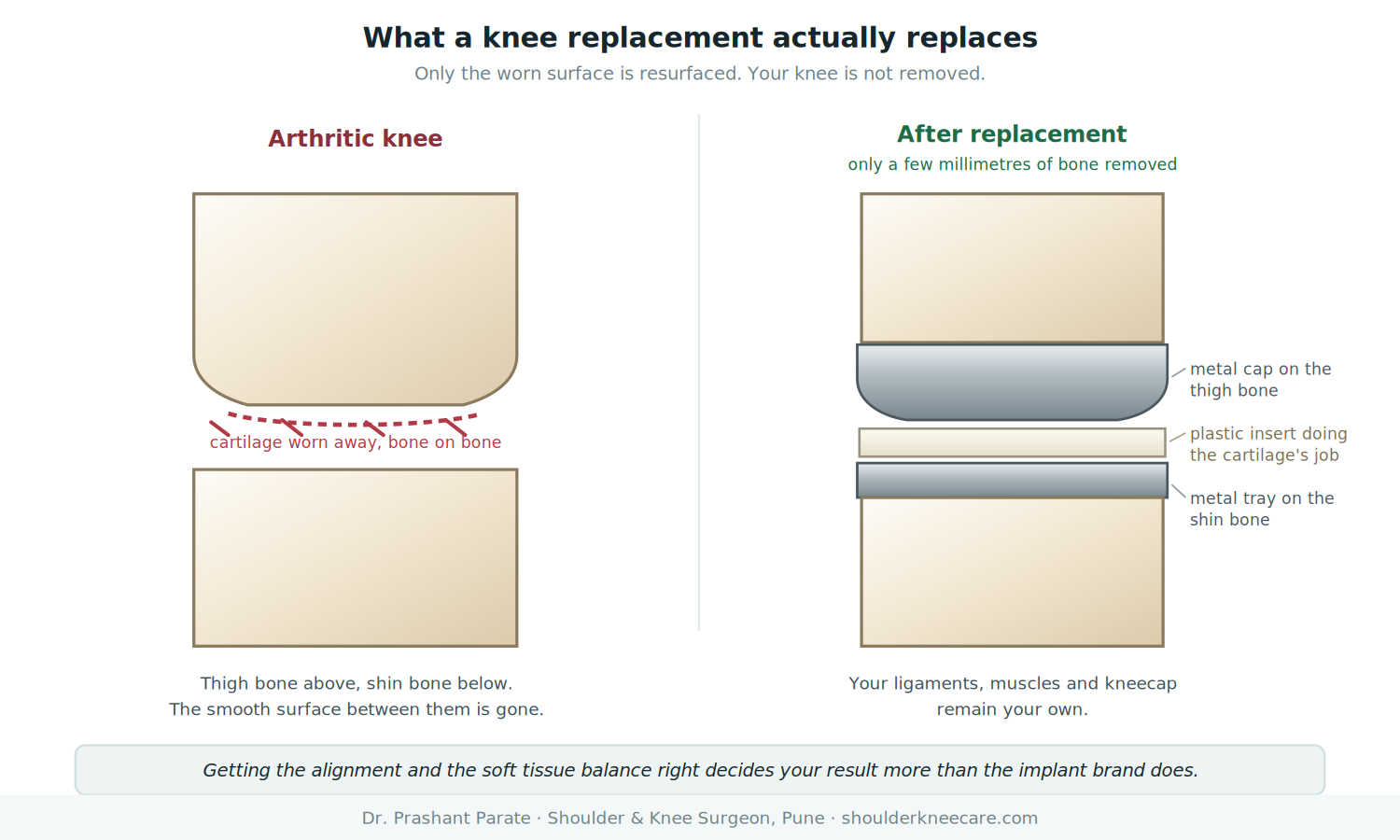
Balancing is the part that decides your result. Cutting bone accurately is necessary but not sufficient. A knee where the soft tissues are too tight on one side, or too loose in bending, will hurt or feel unstable no matter how good the implant is. Most persistent dissatisfaction after knee replacement traces back to balance and alignment rather than to the components.
Before surgery: what actually gets checked
Preparation changes outcomes more than most patients expect, and several items on this list are commonly skipped.
- Standing X-rays and a full-length alignment film, which are used for templating the implant sizes and planning the correction before you reach theatre.
- Diabetes control. This one matters more than any other medical factor. Poorly controlled sugar substantially raises infection risk and slows wound healing. If your HbA1c is high, it is worth delaying surgery to bring it down rather than proceeding on schedule.
- Anaemia correction. Going into surgery anaemic increases the chance of needing transfusion and slows recovery. It is easily treated beforehand and easily overlooked.
- Dental and urinary infection screening. Bacteria from an untreated dental abscess or urinary infection can seed a new implant. Get dental work done before, not after.
- Cardiac and physician clearance where indicated, and a review of blood thinners and diabetes medication.
- Prehabilitation. Quadriceps strength before surgery predicts function afterwards. Patients who arrive stronger recover faster. Even a few weeks helps.
- Home preparation. Plan for a raised toilet seat or commode, a chair of reasonable height, clear floors, and someone available for the first week or two.
Anaesthesia and pain control
Most knee replacements are done under spinal anaesthesia, often with sedation so you are asleep through it. Spinal anaesthesia has advantages over general in this operation, including less blood loss and lower rates of nausea and confusion afterwards, particularly in older patients.
Pain control has changed considerably. Rather than relying on strong opioids, modern practice combines a nerve block, local anaesthetic injected around the joint during surgery, and regular simple analgesia. The aim is not merely comfort. It is to let you stand and walk on the same day or the next morning, because early movement is what prevents stiffness.
Implants: what matters and what does not
Patients are often given a great deal of information about implant brands and very little about what actually differs. The honest summary is that modern implants from established manufacturers perform similarly, and technique matters more than brand.
| Choice | What it means | Does it matter to you? |
| Cemented or uncemented | Whether the components are fixed with bone cement or designed for bone to grow onto them | Cemented remains the reliable standard, particularly in older or softer bone. Both work in the right patient |
| Cruciate retaining or posterior stabilised | Whether the back cruciate ligament is kept or substituted by the implant design | A surgical judgement based on your ligaments and deformity. Outcomes are broadly comparable |
| High flexion designs | Marketed as allowing deeper bending | Bending depends far more on your pre-operative range, your tissues and your rehabilitation than on the implant. Treat the marketing with caution |
| Kneecap resurfacing | Whether the back of the kneecap is resurfaced too | Decided case by case on the state of that surface and your symptoms |
| Premium or standard bearing | Different grades of the plastic insert | Modern highly cross-linked polyethylene wears very slowly. This matters most in younger patients |
Recovery, week by week

| Stage | What happens |
| Day 0 to 1 | You stand and take your first steps with a walker, usually the same evening or the next morning. Physiotherapy starts immediately. Ice and elevation for swelling. |
| Day 2 to 4 | Walking further with support, practising stairs, and getting the knee fully straight, which is the priority. Most patients go home in this window. |
| Week 1 to 3 | Daily home exercises, several short sessions rather than one long one. Bending improves steadily. Walker gives way to a stick as balance returns. Wound review and stitch removal. |
| Week 4 to 6 | Most patients walk indoors without support. Bending typically reaches a functional range. Driving usually becomes possible around six weeks for a left knee sooner, right knee later, once you can brake safely. |
| Month 2 to 3 | Desk work resumes, often earlier. Walking distance increases substantially. Swelling still comes and goes after activity, which is normal and not a setback. |
| Month 3 to 6 | Manual work resumes depending on the job. Confidence on stairs and uneven ground returns. Most patients feel the knee is theirs again around this point. |
| Month 6 to 12 | Continued gradual improvement. The final result is judged at about a year, not at three months. |
Two honest points. Swelling and warmth around the knee for several months is normal and does not mean something is wrong. And the single strongest predictor of your result is how consistently you do the exercises in the first six weeks, particularly the work on getting the knee fully straight.
What you get back, and what you do not
What it reliably gives: relief of arthritic pain, comfortable walking, stairs, sleep without pain, and the return of ordinary daily life. Most patients say they should have done it sooner.
What it does not give: a normal knee. It will feel different. Many patients notice mild numbness on the outer side of the scar, some awareness of the joint, and occasional clicking, none of which indicate a problem.
Deep squatting, kneeling and prolonged cross-legged sitting are usually limited. This matters far more in Indian life than Western guidance reflects, and you deserve to hear it clearly beforehand. Some patients manage floor sitting to a degree, many do not, and it should never be promised. If floor sitting is essential for your work or religious practice, say so before surgery, because it may change the timing or make joint preservation the better route.
Activity afterwards: walking, cycling, swimming and light gym work are encouraged. Running, jumping and contact sport are not, since they shorten implant life.
How long does it last?
Modern knee replacements commonly last fifteen to twenty years or more, and a substantial proportion last considerably longer. Longevity depends on your weight, your activity, the accuracy of the alignment and balancing, and your age at surgery. This is precisely why a younger patient should exhaust joint-preserving options first, since a replacement done at fifty is more likely to need revision within a lifetime than one done at seventy.
Risks, stated plainly
Knee replacement is a safe operation, but it is major surgery and you should know what can go wrong.
- Infection is uncommon but the most serious complication, since it can require further surgery. Risk rises with diabetes, obesity, smoking and untreated infection elsewhere, which is why the preparation list above matters.
- Blood clots in the leg or lung. Prevention is routine: early walking, compression, and blood-thinning medication for a period afterwards.
- Stiffness, usually from insufficient early movement. Occasionally needs manipulation under anaesthesia.
- Persistent pain or dissatisfaction in a small proportion of patients despite a technically sound replacement. This is the most honest limitation of the operation, and it is worth knowing that it exists.
- Numbness along the outer side of the scar, which is common, usually permanent, and rarely troublesome.
- Loosening or wear over many years, which is what revision surgery addresses.
When replacement should be postponed, or not done
Postpone for uncontrolled diabetes, active infection anywhere including teeth and urine, untreated anaemia, unstable cardiac disease, or a smoker who is willing to stop.
Reconsider entirely if the arthritis is mild on standing films and the pain does not match it, if proper strengthening and weight management have never actually been tried, if one compartment only is worn in a younger patient where realignment or partial replacement fits better, or if the expectation is deep squatting and floor sitting afterwards. Surgery cannot deliver that reliably, and a patient expecting it will be unhappy with a technically perfect result.
Cost and insurance in Pune
Total knee replacement in Pune typically ranges between ₹2 and ₹4.5 lakh per knee. The figure varies with hospital category, room type, implant selected, whether robotic assistance is used, your medical comorbidities, and length of stay. Bilateral surgery in one sitting costs less than two separate admissions but is not suitable for everyone.
Most health insurance policies cover knee replacement with cashless treatment at empanelled hospitals, and it is covered under many corporate and government schemes. Three practical points: most policies impose a waiting period of two to four years for joint replacement, so check your policy start date early; some policies cap the implant component; and pre-authorisation should be started several days before a planned date.
Indicative ranges, not quotations. An exact estimate comes from the hospital after assessment.
Frequently asked questions
How much pain should I expect afterwards?
The first two weeks are the demanding part, and modern pain control handles it far better than it once did. Most patients are surprised that the arthritic pain they came in with is gone immediately, replaced by surgical pain that settles steadily. By six weeks most describe discomfort rather than pain.
Can both knees be done at the same time?
In selected fit patients, yes, and it means one admission, one anaesthetic and one rehabilitation period. But it is a bigger physiological hit, needs more support at home, and is decided on your general health rather than convenience. Many patients are better served by doing the worse knee first, which sometimes improves the second knee enough to delay it.
Will I set off airport security scanners?
Possibly, since the components are metal. Airport staff deal with this routinely. An implant card is worth carrying, though most airports now handle it without any documentation.
Can I have an MRI later with a knee replacement?
Yes. Knee implants are MRI-safe. The image quality near the implant itself is degraded, but scans of your spine, brain or any other region are entirely fine.
Do I need antibiotics before dental treatment afterwards?
Guidance has become more selective than it once was. Routine antibiotic cover before every dental visit is no longer recommended for most patients, but it is still considered for higher-risk situations. What matters far more is keeping dental disease treated and telling your dentist you have a joint replacement.
How soon can I climb stairs and use an Indian toilet?
Stairs are practised in hospital before you go home, one step at a time initially, and become comfortable over the following weeks. An Indian toilet requires deep squatting, which is generally not advisable after a knee replacement. Plan for a Western toilet or a commode over the Indian one, and treat this as a permanent arrangement rather than a temporary one.
What if my knee still hurts a year later?
It needs investigating rather than accepting. Causes include infection, alignment or balance problems, kneecap tracking, loosening, stiffness, or pain arising from the hip or spine rather than the knee itself. A structured assessment usually identifies the reason, and several of these are treatable.
Key takeaways
- It is resurfacing, not removal. A few millimetres of worn surface, not your knee.
- Balance and alignment decide your result more than the implant brand does.
- Diabetes control, anaemia and dental infection are the preparation items that most affect outcome, and the ones most often skipped.
- Deep squatting and cross-legged sitting are usually limited afterwards. Anyone promising otherwise is overselling.
- Your effort in the first six weeks matters more than anything else you control.
- Check your insurance waiting period early. Two to four years is common.
Considering a knee replacement?
Bring your standing X-rays. You will get an honest assessment of whether this is the right step now, what it would realistically give you, and what it would not.
Appointments by phone
Sainath Hospital, Moshi, PCMC
86000 05886
Mon to Fri, 10 am to 4 pm · Sat, 10 am to 12 noon
Jupiter Hospital, Baner, Pune
020 2799 2150
Mon to Sat, 5.30 pm to 6.30 pm · OPD 5
All consultations by prior appointment. Timings may vary with the surgical schedule.
This page is patient education, not a substitute for consultation. Treatment decisions require clinical examination and imaging review. Last medically reviewed: July 2026 by Dr. Prashant Parate, DNB Orthopaedics, Fellowship in Arthroscopy & Sports Medicine (Thammasat University Hospital, Thailand). MMC Reg. 2006042129.