SHOULDER · FROZEN SHOULDER GUIDE
Frozen shoulder: the most over-diagnosed shoulder condition in India, and the most badly treated.
Almost every painful shoulder in this country gets labelled frozen shoulder. Many of them are not. And of the ones that genuinely are, most are treated in a way that makes the early months worse rather than better. This guide explains how the diagnosis is actually confirmed, what treatment suits which stage, and when surgery is genuinely required.
Dr. Prashant Parate · Shoulder, Knee & Sports Injury Surgeon · In orthopaedic practice since 2010, DNB-qualified since 2012 · Jupiter Hospital (Baner) & Sainath Hospital (Moshi, PCMC) · Reviewed July 2026
Related: Rotator Cuff Tear: Symptoms, Treatment and When Surgery Is Needed
What frozen shoulder actually is
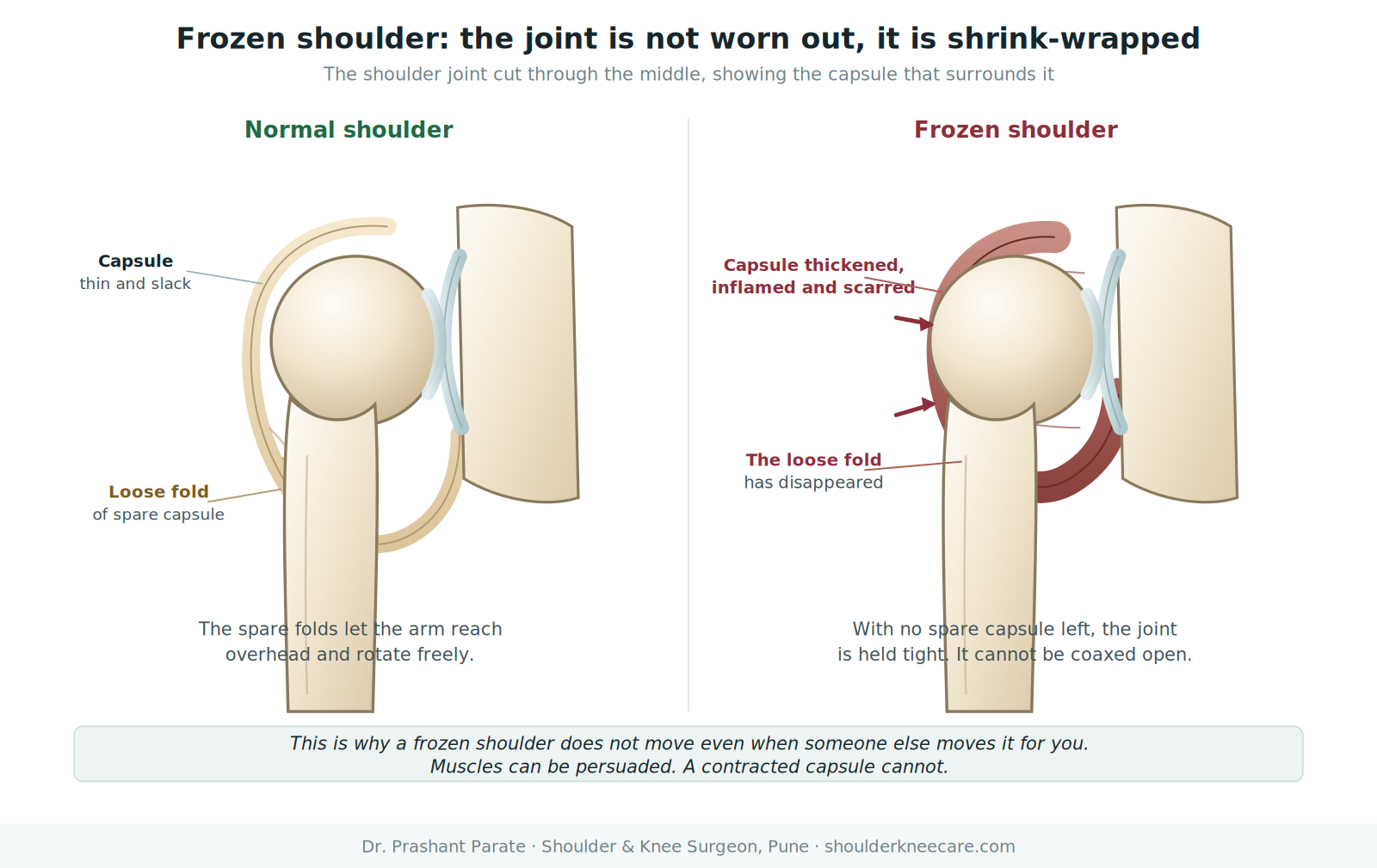
Your shoulder joint sits inside a soft tissue envelope called the capsule. Normally this capsule is loose and generously folded, which is exactly why the shoulder moves further than any other joint in the body.
In frozen shoulder, the capsule becomes inflamed, then thickened, then scarred. Its folds contract and it shrink-wraps the joint. The medical name, adhesive capsulitis, describes this directly. Nothing is torn and nothing is worn out. The joint is simply held in a sleeve that has become too tight for it.
This matters because it explains the single most important feature of the condition: the shoulder will not move even when someone else moves it for you. Muscles can be coaxed. A contracted capsule cannot.
Is it really frozen shoulder? The test that settles it
There is one clinical finding that separates frozen shoulder from almost everything else, and most patients have never had it checked properly.
Loss of passive external rotation
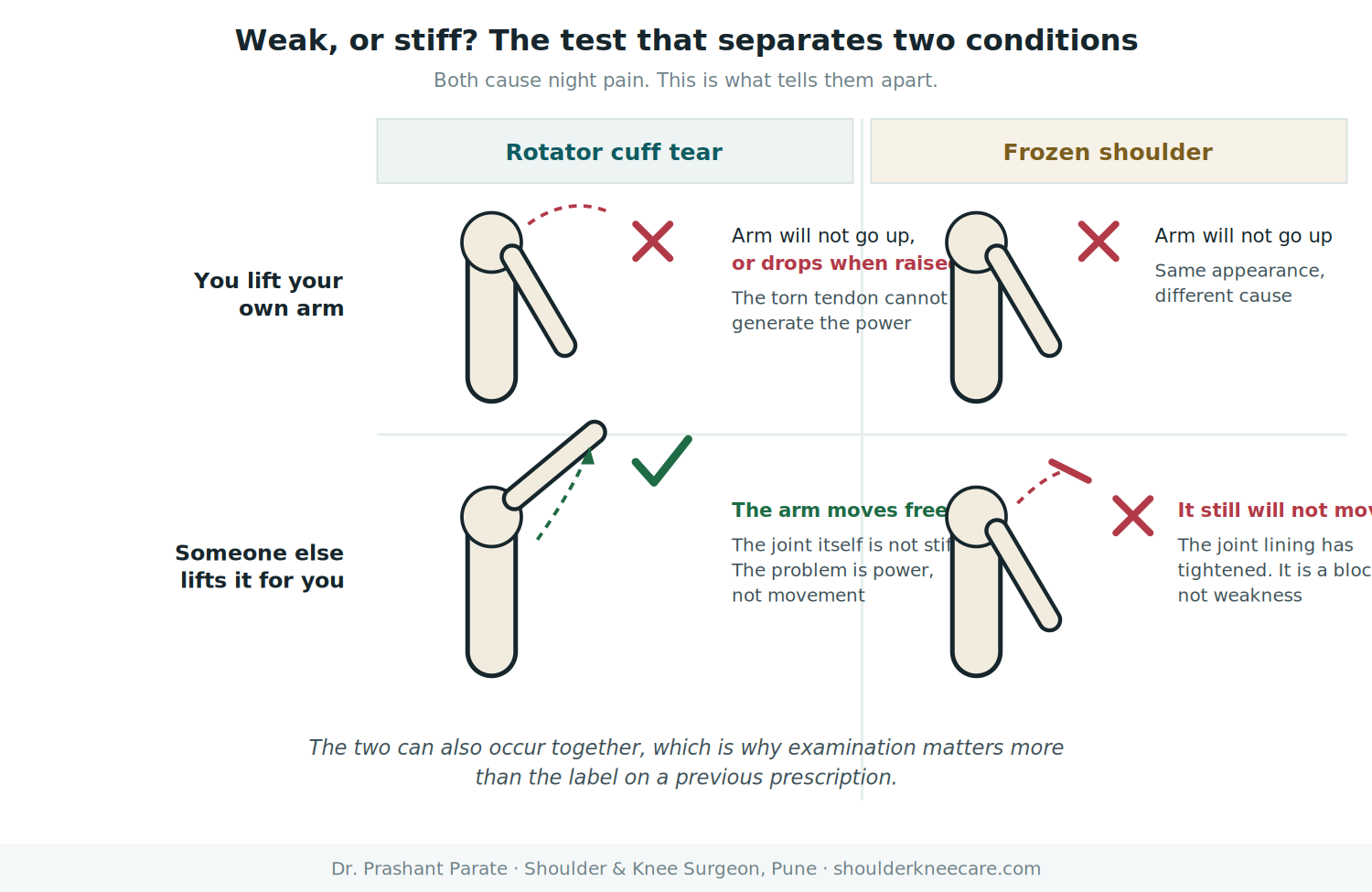
Keep your elbow tucked against your side, bent to a right angle. Now let someone else gently turn your forearm outward, away from your stomach. In a normal shoulder it rotates out comfortably. In a genuine frozen shoulder it stops early and hard, and it stops whether you push or someone else does. That block is the signature of a contracted capsule, and it is not produced by a rotator cuff tear, by cervical spondylosis, or by ordinary shoulder pain.
This is why a torn rotator cuff and a frozen shoulder feel similar to the patient but are entirely different problems. A cuff tear is weakness, and the arm moves well when someone lifts it for you. Frozen shoulder is stiffness, and the arm does not move regardless of who is moving it.
Who gets it, and why diabetes changes everything
Frozen shoulder typically appears between the ages of 40 and 60, and affects women more often than men. It commonly arrives with no injury at all, which is one reason patients find it so bewildering.
Diabetes is by far the most important association, and it matters enormously in India. People with diabetes develop frozen shoulder several times more often than those without, are more likely to get it in both shoulders, tend to have more severe restriction, and recover more slowly. If you are diabetic and your shoulder has begun stiffening, do not adopt a wait-and-watch approach. Your condition behaves differently and deserves earlier, more active treatment.
Thyroid disorders carry a similar though weaker link. And a second group develops secondary stiffness, where the shoulder freezes after something else: a fracture near the shoulder, a period of immobilisation in a sling, a cuff problem that stopped you using the arm, or previous surgery. Secondary stiffness follows different rules and often needs intervention sooner.
The three phases, and why they decide your treatment
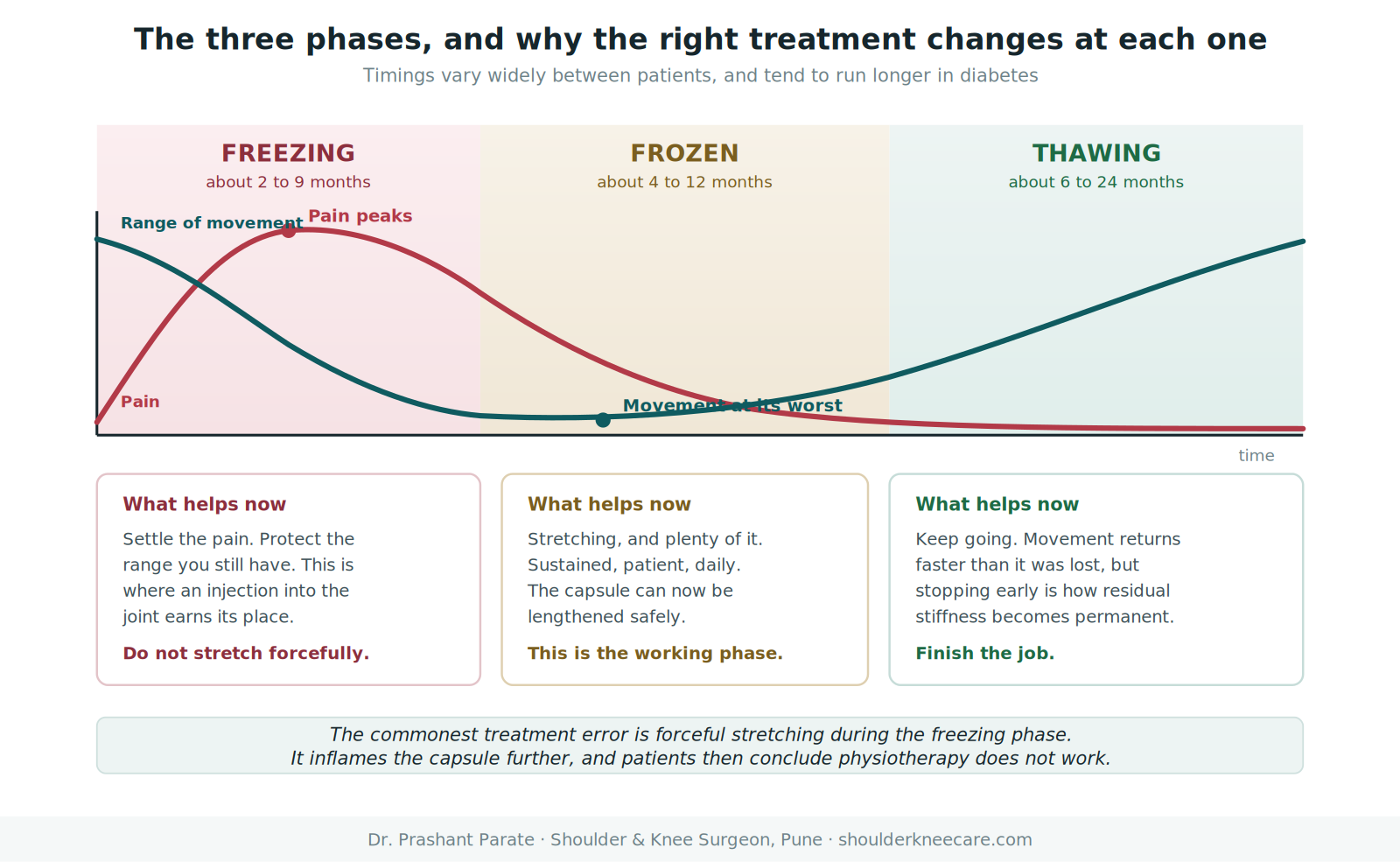
Frozen shoulder is not one condition throughout its course. It passes through three distinct phases, and the correct treatment in one phase is the wrong treatment in another. This is where most treatment goes astray.
| Phase | What you feel | What actually helps |
| Freezing roughly 2 to 9 months |
Pain dominates, often severe and worst at night. Movement is shrinking week by week. | Settle the pain, protect the range you still have. Aggressive stretching now increases inflammation and makes the freezing worse. This is the phase where an injection earns its place. |
| Frozen roughly 4 to 12 months |
Pain settles considerably. Stiffness is now the problem. Daily tasks become the difficulty. | This is when stretching does its work. Sustained, patient, daily stretching. Now the capsule can be lengthened without inflaming it further. |
| Thawing roughly 6 to 24 months |
Movement gradually returns, usually faster than it was lost. | Keep going. Most people stop exercising the moment comfort returns, which is precisely how residual stiffness becomes permanent. |
The single most common mistake I see is forceful physiotherapy during the freezing phase. A painful, actively inflamed shoulder that is pushed hard responds by becoming more inflamed and stiffer. Patients then conclude that physiotherapy does not work, when the problem was the timing rather than the treatment.
Diagnosis: mostly your examination, not a scan
Frozen shoulder is a clinical diagnosis. The pattern of restriction, particularly the loss of passive external rotation, establishes it. Scans are used mainly to rule out other things rather than to confirm this one.
X-rays are usually normal, which is itself useful because it excludes arthritis. MRI may show a thickened capsule but is not required in a typical case. Where MRI genuinely helps is when the picture is mixed, for example a stiff shoulder that may also have a cuff tear, or stiffness after an injury. Blood sugar and thyroid testing are worth doing in anyone presenting with frozen shoulder, because a meaningful number of patients discover undiagnosed diabetes this way.
The decision pathway
1. Is passive external rotation genuinely restricted?
If not, this is probably not frozen shoulder, and treating it as one wastes months. A stiff-feeling shoulder that moves freely when someone else moves it is a cuff or impingement problem instead. Confirm the diagnosis before treating it.
2. Which phase are you in, painful or stiff?
If pain dominates and range is still shrinking, the priority is settling inflammation, not stretching harder. If pain has faded and stiffness remains, stretching becomes the main treatment. Matching the treatment to the phase changes results more than any single technique. Treat the phase, not the label.
3. Are you diabetic?
Then expect a longer and more stubborn course, watch the other shoulder, and get blood sugar under proper control, because it directly affects how the shoulder behaves. Diabetic frozen shoulders reach the point of needing intervention more often than others. Treat actively, review sooner.
4. Did the stiffness follow an injury, a fracture, a sling, or surgery?
This is secondary stiffness, and it does not reliably resolve with time the way primary frozen shoulder tends to. It usually needs earlier and more structured treatment, and sometimes release. Do not simply wait this one out.
5. Have you had six months of genuinely correct treatment with no meaningful progress?
Then it is reasonable to consider arthroscopic capsular release. The word correct matters, because heat packs and a few ultrasound sessions are not a trial of treatment. A structured, phase-appropriate programme is. Consider release.
6. Is the restriction severe enough to be disabling your work or sleep?
Severity, not just duration, is a legitimate reason to intervene earlier. A shoulder that cannot reach the back or lift overhead in someone who needs both for their livelihood is not a shoulder to leave for another year. Individual, not calendar-based.
Treatment options, honestly assessed
| Treatment | What it does | Where it fits |
| Phase-appropriate physiotherapy | Protects range early, lengthens the capsule later | The backbone of treatment for almost everyone, throughout |
| Intra-articular steroid injection | Reduces capsular inflammation and pain, allowing useful exercise to begin | Genuinely valuable in the painful freezing phase. Best given into the joint, and it is the timing that decides the benefit |
| Hydrodilatation | Fluid is used to stretch the contracted capsule from inside | A useful step between injection and surgery in selected patients |
| Arthroscopic capsular release | The tight capsule is divided under keyhole vision, restoring movement in one sitting | For shoulders that have not responded to proper treatment, and for severe or secondary stiffness |
| Manipulation under anaesthesia alone | The capsule is torn by forced movement while you are asleep | Largely superseded. It tears the capsule blindly, with a real risk of fracture in weaker bone. I prefer controlled release under vision |
| Painkillers and heat alone | Temporary comfort | Supportive only. On their own they change nothing about the course |
Does it really get better on its own?
Partly, and this is where patients are frequently misled. Frozen shoulder is usually described as self-limiting, meaning it settles eventually without treatment. That is broadly true, but two things are left out.
First, eventually can mean one to three years, during which sleep, work and daily life are meaningfully affected. Second, a substantial minority of patients are left with permanent residual restriction, often losing the last part of overhead reach or the ability to reach behind the back. Diabetic patients are over-represented in that group.
So “it will settle by itself” is not wrong, but it is not a treatment plan either. Good treatment shortens the course, controls the pain, and protects you from ending up in the group with lasting stiffness.
If release is needed: what happens
Arthroscopic capsular release is keyhole surgery. Through small portals, the thickened capsule is divided under direct camera vision, in a controlled sequence, until the shoulder moves freely on the table. Because it is done under vision rather than by force, the release goes exactly where the tightness is and the bone is not put at risk.
The surgery is the smaller half of the treatment. The range gained in theatre has to be held, and that is done through physiotherapy starting within a day or two, with no sling and no period of rest. A patient who does the rehabilitation keeps what the surgery gave them. A patient who does not will stiffen again, and no surgical technique prevents that.
Recovery after capsular release
| Stage | What happens |
| Day 1 to 2 | Physiotherapy begins immediately. No sling. Holding the range gained is the entire priority, and pain relief is arranged so that movement is possible. |
| Week 1 to 6 | Frequent daily movement, several short sessions rather than one long one. Most daily activities return during this period. |
| Week 6 to 12 | Strengthening is added once range is secure. Driving and routine work resume. |
| Month 3 to 6 | Final range and confidence return. Overhead and heavy work resume. |
This is a general guide. Your individual protocol is given to you after surgery and takes account of your findings, your diabetes control and your work.
Cost and insurance in Pune
Non-surgical treatment involves consultation, physiotherapy sessions and, where indicated, an injection or hydrodilatation, and remains relatively modest in cost. Arthroscopic capsular release in Pune typically ranges between ₹1.5 and ₹2.5 lakh, depending on hospital category and room type.
Most health insurance policies cover arthroscopic capsular release, cashless at empanelled hospitals. Physiotherapy and injections given in the outpatient setting are usually not covered, since most policies pay only for admitted treatment. Begin pre-authorisation several days before a planned surgical date.
Indicative ranges, not quotations. An exact estimate is given after examination.
Frequently asked questions
How long does frozen shoulder last?
Left alone, commonly one to three years across all three phases. With correct phase-appropriate treatment, most people are substantially better well inside a year. The variation is wide, and diabetes tends to lengthen it.
Why is my shoulder so much worse at night?
Night pain is characteristic of the freezing phase, when the capsule is actively inflamed. Lying down removes the small distraction of the joint that gravity provides during the day, and inflammatory pain naturally intensifies at rest. Sleeping propped up with a pillow supporting the arm helps many patients get through this phase.
My physiotherapist is stretching my shoulder hard and it is getting worse. Is that normal?
It is common, and it is usually a timing error. Forceful stretching of an actively inflamed capsule in the freezing phase provokes more inflammation and more stiffness. In that phase the goal is settling pain and maintaining what range you have. Vigorous stretching belongs to the frozen phase, once the pain has subsided. If your shoulder is worsening under treatment, the programme needs reviewing rather than intensifying.
Will it happen in my other shoulder too?
It can. Involvement of the second shoulder is well recognised, and it is more likely in diabetic patients. The reassurance is that the same shoulder rarely freezes twice. If the second shoulder does begin stiffening, recognising it early is a real advantage, because early treatment works better than late.
Is a steroid injection safe here? I have read they are harmful.
The caution about repeated steroid injections applies mainly to tendons, where steroid weakens tissue and can compromise later repair. Frozen shoulder is a different situation: the target is an inflamed joint capsule, not a tendon, and a well-placed injection into the joint during the painful phase has good evidence behind it. The principle remains sensible use rather than repeated injections given indefinitely.
Can frozen shoulder be caused by cervical spondylosis?
No, though the two are frequently confused and can coexist. Neck problems typically cause pain that radiates down the arm, often with tingling or numbness, and neck movement reproduces the symptoms. Frozen shoulder restricts the shoulder itself, in a specific pattern, regardless of what the neck does. Many patients spend months on neck treatment before the shoulder is examined properly.
Can I keep working through it?
Most people can, with adjustments. Overhead work and heavy lifting on the affected side become difficult, and tasks such as reaching behind for a seatbelt, fastening clothing at the back or reaching a high shelf are usually the first casualties. Complete rest is not advisable, since the shoulder stiffens faster when it is not used within its comfortable range.
Will the stiffness come back after surgery?
It can, and the main determinant is what happens in the first few weeks afterwards. This is why rehabilitation starts within a day or two rather than after a period of rest, and why there is no sling. Patients who follow the programme keep their range. Diabetic patients need to be particularly diligent, and their sugar control genuinely affects the outcome.
Key takeaways
- Confirm the diagnosis first. Genuine frozen shoulder restricts passive external rotation. If the shoulder moves when someone else moves it, look elsewhere.
- Treat the phase, not the label. Pain control early, stretching later. Reversing that order is the commonest reason treatment fails.
- Diabetes makes it more likely, more severe and slower, and it deserves earlier active treatment.
- Stiffness that followed an injury, a sling or surgery behaves differently and should not simply be waited out.
- It usually settles with time, but time can mean years, and some patients are left with permanent restriction. Treatment shortens the course and protects the result.
Stiff shoulder that is not improving? Have the diagnosis confirmed.
One examination usually settles whether this is frozen shoulder, a cuff problem, or something else, and which phase you are in. That single answer determines whether your current treatment is helping you or holding you back.
Appointments by phone
Sainath Hospital, Moshi, PCMC
86000 05886
Mon to Fri, 10 am to 4 pm · Sat, 10 am to 12 noon
Jupiter Hospital, Baner, Pune
020 2799 2150
Mon to Sat, 5.30 pm to 6.30 pm · OPD 5
All consultations by prior appointment. Timings may vary with the surgical schedule.
This page is patient education, not a substitute for consultation. Treatment decisions require clinical examination. Last medically reviewed: July 2026 by Dr. Prashant Parate, DNB Orthopaedics, Fellowship in Arthroscopy & Sports Medicine (Thammasat University Hospital, Thailand). MMC Reg. 2006042129.