KNEE · MENISCUS INJURY GUIDE
Meniscus tear: why “removing the torn part” is sometimes the worst option for your knee.
The meniscus is your knee’s shock absorber, and once removed, it never grows back. Yet trimming it out is still offered as the default everywhere. This guide explains when a meniscus can and should be repaired, when removal is genuinely the right choice, when your leg alignment must be corrected for the repair to survive, and when surgery is not needed at all.
Dr. Prashant Parate · Fellowship-trained Arthroscopy & Sports Injury Surgeon · Jupiter Hospital (Baner) & Sainath Hospital (Moshi, PCMC) · Reviewed July 2026
Related: ACL Tear & Reconstruction: Complete Guide (meniscus tears often occur together with ACL injuries)
What the meniscus is, and why it matters so much
Each knee has two menisci: C-shaped cushions of tough cartilage sitting between the thigh bone and shin bone. The medial meniscus on the inner side, the lateral meniscus on the outer side. Together they absorb shock, spread your body weight across the joint, and stabilise the knee.
Here is the fact that should shape every treatment decision: meniscus tissue that is removed never regenerates. Losing meniscus permanently increases the pressure on your joint cartilage, which is why studies consistently link meniscus removal with earlier arthritis. This is the reason modern arthroscopy follows one philosophy: save the meniscus wherever it can be saved.
Two very different injuries with the same name
1. Traumatic tears (usually under 40): a twisting injury during sport such as football, kabaddi or badminton, or a fall with the foot planted. Often occurs together with an ACL tear. These tears happen in healthy tissue, and many of them are repairable.
2. Degenerative tears (usually over 40): the meniscus wears and frays with age, sometimes tearing with something as trivial as squatting or getting up from the floor. These are extremely common. And here is what many patients are never told: a degenerative tear seen on MRI is often not the true cause of the pain, and most do not need surgery at all.
Symptoms: what a torn meniscus feels like
Pain localised to the joint line (inner or outer side of the knee), swelling that appears hours after activity, clicking or catching sensations, pain on squatting or twisting, and in larger tears, locking, where the knee gets stuck and cannot fully straighten. A locked knee from a displaced (bucket-handle) tear is one situation where surgery becomes urgent rather than optional.
Diagnosis: examination first, then MRI, then alignment
Clinical examination (joint line tenderness, provocation tests like McMurray’s) combined with your injury story usually points to the diagnosis. Imaging then answers three separate questions:
- MRI, question one: location and blood supply. The outer third of the meniscus (“red zone”) has blood supply and can heal after repair. The inner third (“white zone”) has none; tears there cannot heal even if stitched.
- MRI, question two: tear pattern. Longitudinal and bucket-handle tears are often repairable; radial tears sometimes; horizontal and complex degenerative tears usually are not. Root tears are a special category: the meniscus tears at its bony anchor, making the entire meniscus functionless even though it looks intact. A torn root behaves as if the meniscus were removed.
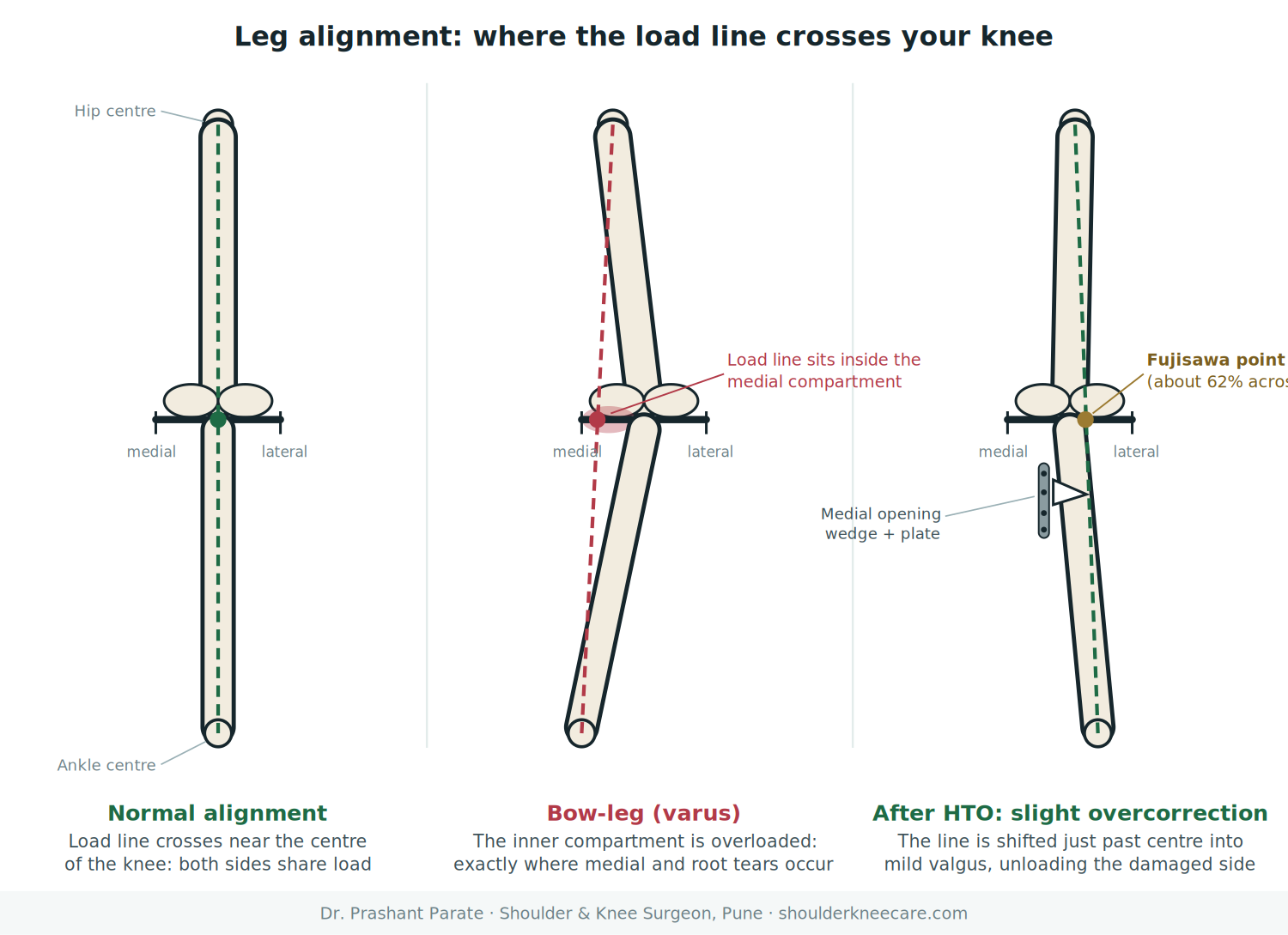
- Standing alignment X-ray, question three: how does your leg carry load? A full-length standing X-ray from hip to ankle shows whether your leg is bow-legged (varus) or knock-kneed (valgus). This is not routine everywhere, but it is crucial: alignment decides how much load crosses the torn side of the knee, and therefore whether a repair will survive. In medial meniscus tears, and especially medial root tears, checking alignment is not optional.

The decision pathway: repair, remove, realign, or leave alone?
1. Is it a degenerative tear in a knee over 40, without locking?
Start with structured physiotherapy for 8–12 weeks, not surgery. High-quality studies show that for most degenerative tears, supervised exercise gives results comparable to arthroscopic trimming, without any operation. Surgery enters the picture only if genuine mechanical symptoms persist despite proper rehab. Physiotherapy first.
2. Is the knee locked, or does it repeatedly catch and give way?
A displaced fragment blocking the joint, classically a bucket-handle tear, needs prompt arthroscopy. Delay keeps the fragment grinding cartilage and can make a repairable tear irreparable. Surgery, and sooner rather than later.
3. Is it a traumatic tear in the red (outer) zone of a younger patient?
This is the classic case for repair: stitching the tear so your own meniscus heals and protects the knee for decades. The younger the patient and the fresher the tear, the stronger the case. Repair, not removal.
4. Is there an ACL tear as well?
Meniscus repairs heal best when done together with ACL reconstruction; the healing environment of the reconstructed knee improves repair success. This combination is also a reason not to delay the ACL surgery. Combined surgery.
5. Is your leg bow-legged (varus), especially with a medial or root tear?
A varus leg overloads the inner compartment of the knee: the exact place where medial meniscus and root tears occur. Repairing the meniscus while leaving that overload uncorrected is like patching a tyre and driving on the same nail. In these knees, high tibial osteotomy (HTO), a realignment of the shin bone, shifts load away from the damaged side. Depending on the case, HTO is done together with root repair to protect it, or is itself the main treatment when early arthritis has begun. Correct the alignment, then (or while) fixing the meniscus.
6. Is the tear genuinely irreparable: white zone, complex, or failed repair?
Then partial meniscectomy, removing only the torn, unstable fragment while preserving every millimetre of healthy meniscus, is the right operation. Done for the right tear, it relieves symptoms quickly. The mistake is not meniscectomy itself; it is meniscectomy done where repair was possible, or surgery done where none was needed. Minimal, precise removal.
Repair vs removal: what each means for you
| Meniscus Repair | Partial Meniscectomy | |
| What is done | Tear is stitched with special anchors and sutures through the arthroscope | Only the torn fragment is trimmed away |
| Early recovery | Slower: protected weight-bearing and brace for around 4–6 weeks to let the repair heal | Fast: walking immediately, mostly normal by 2–4 weeks |
| Return to sport | Around 4–6 months | Around 4–8 weeks |
| Long-term knee health | Meniscus preserved: best protection against arthritis | Lost tissue never returns; arthritis risk rises with amount removed |
| Main risk | Repair may not heal (roughly 1 in 10–20 need re-surgery, depending on tear type) | Long-term cartilage overload |
Why I lean toward repair whenever the tear allows it: the slower recovery is a price paid once; a lost meniscus is paid for over a lifetime. In a young patient, accepting a few extra weeks of rehab in exchange for decades of joint protection is almost always the right trade.
Recovery timeline
| Stage | After repair | After partial meniscectomy |
| Week 0–2 | Brace, protected weight-bearing with support, gentle bending limits | Walking from day one, swelling control |
| Week 2–6 | Gradual weight-bearing and bend progression per protocol | Mostly normal daily life by week 2–4 |
| Week 6–12 | Full weight-bearing, strengthening; deep squatting still restricted | Strengthening; return to light sport |
| Month 3–6 | Progressive return to sport after strength testing (4–6 months) | Full activity |
Root repairs and repairs combined with HTO follow a more protective early protocol; your individual plan is given at surgery.
Cost of meniscus surgery in Pune
Arthroscopic meniscus surgery in Pune typically ranges between ₹1 and ₹2.5 lakh. Repair costs more than trimming because of the implants (all-inside repair devices) used. Combined procedures such as ACL plus meniscus, root repair, or repair with HTO are priced as one surgery with add-ons, discussed case by case. Most insurance policies cover arthroscopic meniscus surgery and HTO, cashless at empanelled hospitals; mention traumatic injury where applicable and initiate pre-authorisation early.
Indicative ranges, not quotations. An exact estimate is given after examination and imaging review.
Meniscus tear: frequently asked questions
Can a meniscus tear heal on its own?
Small tears in the outer (red) zone, the part with blood supply, can heal with protection and rehab. Tears in the inner (white) zone cannot. Degenerative tears don’t “heal”, but most become painless with strengthening, which is why physiotherapy, not surgery, is their first treatment.
My MRI shows a meniscus tear but my knee doesn’t trouble me much. Do I need surgery?
Usually no. MRI-detected degenerative tears are extremely common in people over 40 with no symptoms at all. We treat the patient, not the scan. Surgery is for knees with genuine mechanical symptoms that persist despite proper rehabilitation.
What happens if I ignore a bucket-handle tear or a locked knee?
The displaced fragment keeps grinding the joint cartilage, the tear becomes irreparable with time, and the knee cannot straighten fully. This is one meniscus situation where delay genuinely closes doors. Prompt arthroscopy can often save the meniscus.
What is a meniscus root tear, and why does everyone seem worried about it?
The root is the meniscus’s bony anchor at the centre of the knee. When it tears, the whole meniscus stops working even though it looks intact: hoop tension is lost, pressure on the cartilage rises sharply, and arthritis can progress within a few years. Repaired in time, root fixation can change that trajectory. This is why a “root tear” on your MRI report deserves a specialist opinion promptly.
How is a meniscus root repair actually done?
Arthroscopically, through keyhole portals. Strong sutures are passed through the torn root, then pulled down through a small bone tunnel in the shin bone and fixed there, anchoring the root back to its natural attachment point so it can heal to bone. Because the repair must heal under load, the early weeks are deliberately protective: brace and restricted weight-bearing, typically for about six weeks, with squatting delayed further. Done in time, and in a well-aligned leg, root repair restores the meniscus’s function rather than sacrificing it.
My surgeon mentioned HTO and “alignment correction” for my meniscus problem. Why is bone surgery needed for a cartilage cushion?
Because load decides whether the repair survives. If your leg is bow-legged (varus), body weight passes disproportionately through the inner compartment, the exact spot where medial and root tears occur. High tibial osteotomy (HTO) is a controlled correction of the upper shin bone that shifts load toward the healthy side of the knee. In a varus knee with a root tear or early inner-compartment arthritis, HTO protects the repair, relieves pain, and can postpone knee replacement by many years. It is joint-preserving surgery: you keep your own knee.
Can I sit cross-legged and squat after meniscus surgery?
After partial meniscectomy: yes, usually within weeks. After repair: yes, but deep squatting and cross-legged sitting are deliberately delayed for about three months to protect the healing repair. In the long run, the repaired knee is the one more likely to squat comfortably for decades.
Is an injection an alternative to surgery?
Injections don’t repair torn tissue. For degenerative tears being managed without surgery, an injection occasionally helps settle inflammation as part of a rehab program, but it is a supporting actor, never the treatment of the tear itself.
Key takeaways
- Removed meniscus never grows back: save it wherever it can be saved.
- Degenerative tears over 40: physiotherapy first; surgery only for persistent mechanical symptoms.
- Locked knee or bucket-handle tear: surgery promptly, because delay makes repairs impossible.
- Traumatic red-zone tears in the young: repair, not removal.
- Root tears are urgent even when the knee “works”: get a specialist opinion.
- Alignment is crucial: a bow-legged (varus) knee overloads a medial or root repair. Checking standing alignment, and correcting it with HTO where needed, is what makes the repair last.
Told you need your meniscus “trimmed”? Ask two questions first.
Ask whether your tear is repairable, and ask whether your alignment has been checked. Bring your MRI: in one consultation we’ll tell you honestly whether your meniscus can be saved, whether your alignment needs attention, or whether no surgery is needed at all.
Appointments by phone
Sainath Hospital, Moshi, PCMC
86000 05886
Mon to Fri, 10 am to 4 pm · Sat, 10 am to 12 noon
Jupiter Hospital, Baner, Pune
020 2799 2150
Mon to Sat, 5.30 pm to 6.30 pm · OPD 5
All consultations by prior appointment. Timings may vary with the surgical schedule.
This page is patient education, not a substitute for consultation. Treatment decisions require clinical examination and imaging review. Last medically reviewed: July 2026 by Dr. Prashant Parate, DNB Orthopaedics, Fellowship in Arthroscopy & Sports Medicine (Thammasat University Hospital, Thailand).