KNEE · PAIN AND DIAGNOSIS
Knee pain: your age and the exact spot it hurts narrow it down faster than any scan.
Most people arrive at a knee clinic with a scan and no explanation. This page works the other way round. Four questions and the location of your pain will usually tell you which of about a dozen conditions you are dealing with, and whether you need imaging at all.
Dr. Prashant Parate · Shoulder, Knee & Sports Injury Surgeon · In orthopaedic practice since 2010, DNB-qualified since 2012 · Jupiter Hospital (Baner) & Sainath Hospital (Moshi, PCMC) · Reviewed July 2026
Start with where it hurts
Point to your knee with one finger. Not a general wave at it, one finger on the spot that hurts most. The location alone rules a great deal in and out, and it is the first thing I ask in the OPD.
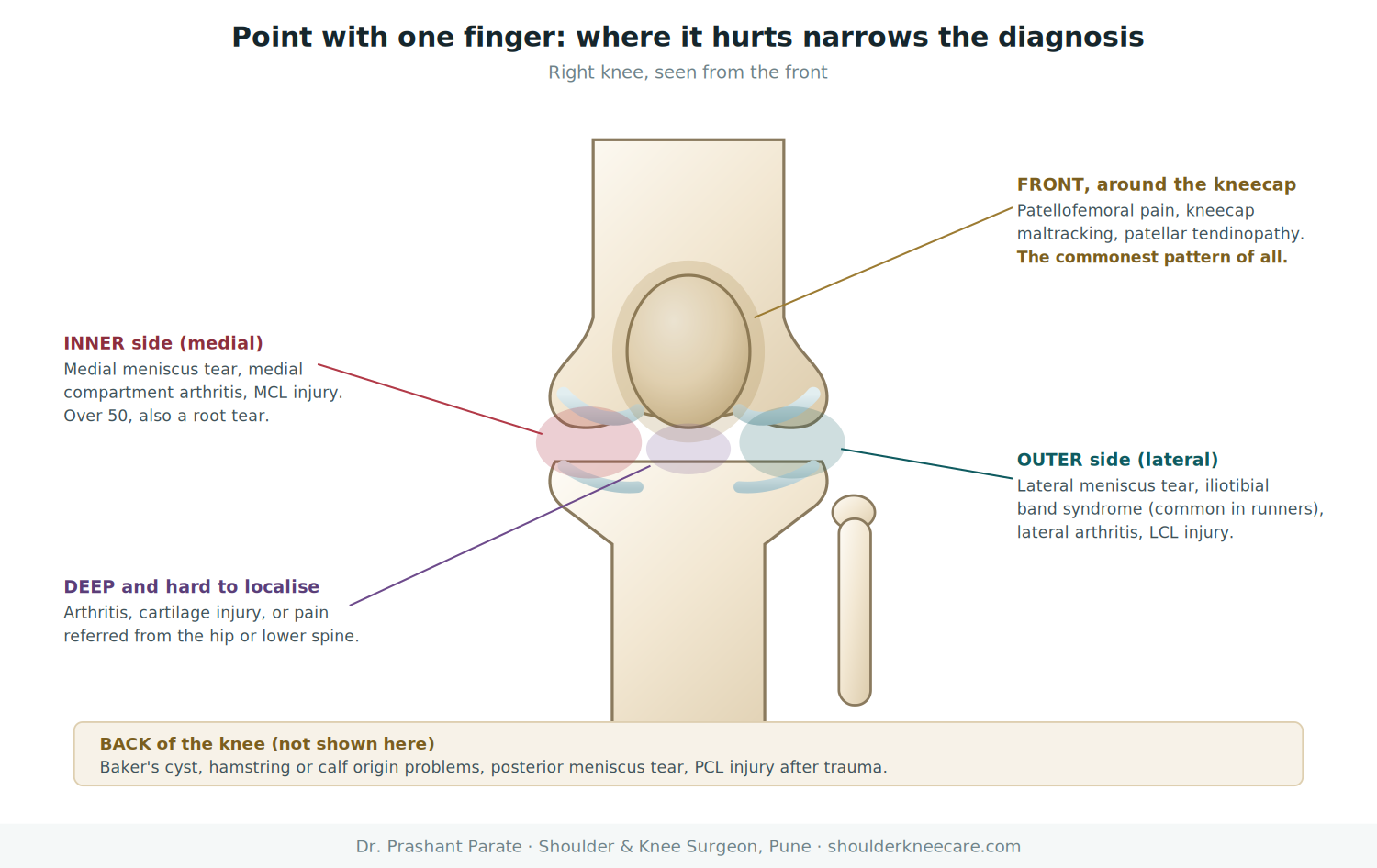
| Where it hurts | Usual suspects |
| Front, around or under the kneecap | Patellofemoral pain, kneecap maltracking, patellar tendinopathy, early patellofemoral arthritis. The commonest pattern of all, and the least often explained properly. |
| Inner side (medial) | Medial meniscus tear, medial compartment arthritis, MCL injury, and in older patients a meniscus root tear. |
| Outer side (lateral) | Lateral meniscus tear, iliotibial band syndrome (very common in runners), lateral compartment arthritis, LCL injury. |
| Back of the knee | Baker’s cyst, hamstring or calf origin problems, posterior meniscus tear, PCL injury after trauma. |
| Deep and hard to localise | Arthritis, cartilage injury, or pain referred from the hip or lower spine. |
The four questions that narrow it fastest
These four, in this order, do more diagnostic work than a scan.
1. How old are you, and how active?
This is the single strongest discriminator. The same complaint means entirely different things at 22 and at 62. Age changes the probabilities more than any individual symptom does.
2. Was there a specific injury, or did it come on gradually?
A twisting injury, a fall, or a two-wheeler accident points to ligament, meniscus or bone. Pain that appeared over months without any event points to wear, overload or inflammation. Patients often forget a minor twist from weeks earlier, so think back properly.
3. Did it swell, and how quickly?
The timing matters more than the amount. Swelling within an hour or two of an injury usually means bleeding inside the joint, which suggests an ACL tear, a fracture or a kneecap dislocation. Swelling that appears the next morning is more typical of a meniscus tear. Swelling that comes and goes over months, unrelated to injury, suggests arthritis or inflammation.
4. Does it lock, catch, or give way?
These are mechanical symptoms and they are the ones that most often mean something structural. Locking suggests a fragment blocking the joint. Giving way suggests instability from a ligament, or from the kneecap slipping. Pain without any mechanical symptom is more often overload or wear.
What your age suggests

Under about 30, or any age if you are athletic
Pain here is usually injury or overload rather than wear. With a clear injury, think ACL tear, meniscus tear, kneecap dislocation, or ligament injury on the inner or outer side. Without an injury, the commonest causes are patellofemoral pain from kneecap maltracking, patellar tendinopathy from jumping sports, and iliotibial band syndrome in runners.
One specific pattern worth knowing: a young knee that gives way repeatedly, or that has dislocated its kneecap more than once, has a structural reason for doing so and is worth assessing rather than tolerating.
Roughly 30 to 50
This is the overlap decade, and the group most often misdiagnosed in both directions. Both injury patterns and early wear occur, and frequently together. Degenerative meniscus tears begin appearing, cartilage damage from an old injury starts declaring itself, and early arthritis can begin, particularly in a knee that had surgery or an untreated ligament injury years ago.
The important nuance here: an MRI in this age group will frequently report a meniscus tear that is not actually the source of the pain. Worn knees have worn menisci. Treating the scan rather than the patient leads to unnecessary arthroscopy.
Over about 50
Arthritis becomes the most likely explanation, and the pattern is characteristic: pain on stairs, difficulty squatting or sitting cross-legged, stiffness after sitting, and swelling after a long day. See the knee arthritis guide for how that is assessed and treated.
Two things in this group are commonly missed. A meniscus root tear can cause a sudden increase in pain in an arthritic knee and behaves quite differently from ordinary wear. And pain felt in the knee is sometimes coming from the hip, which is worth excluding before any knee treatment begins.
What each symptom actually means
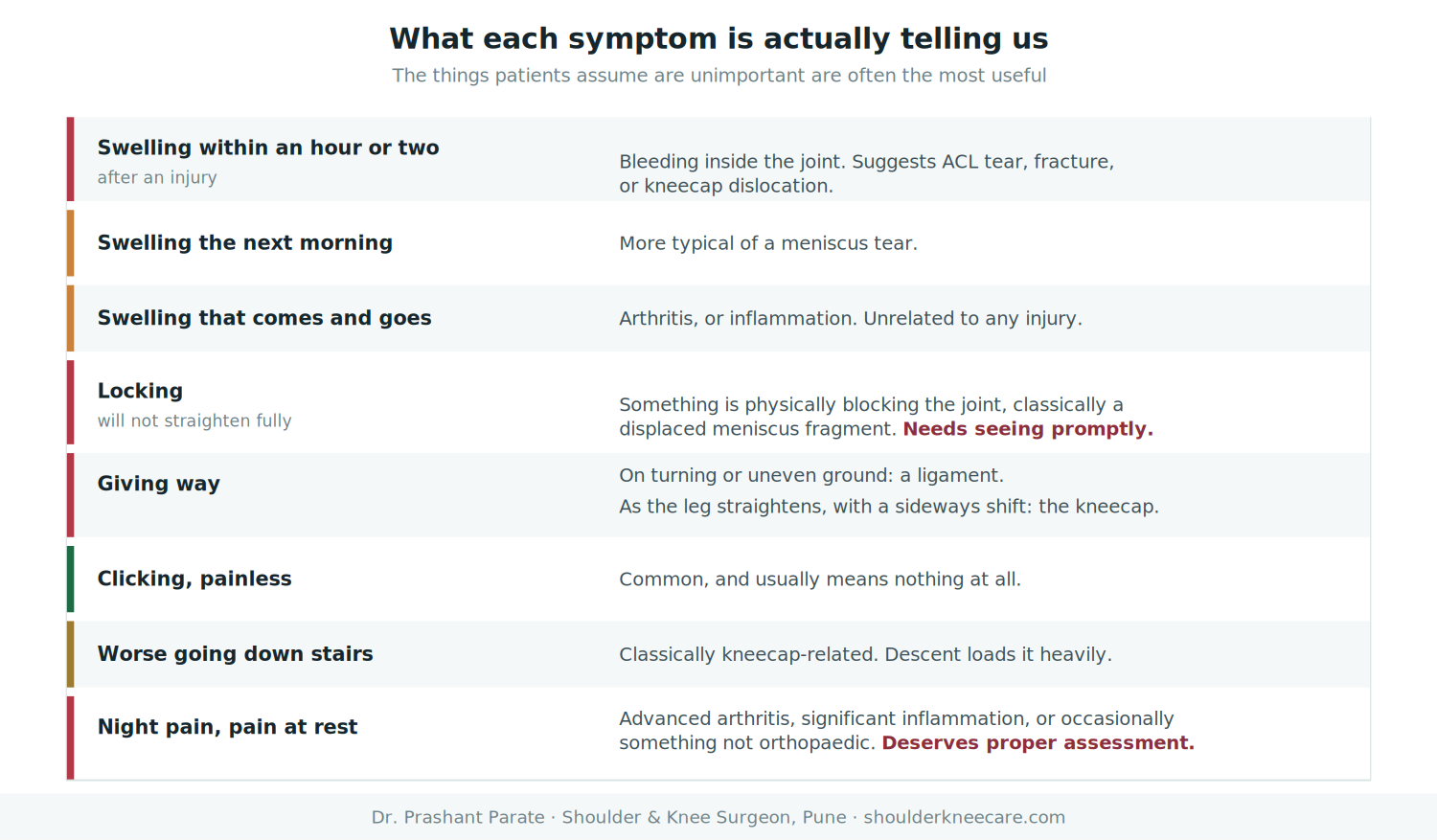
Patients often describe symptoms they assume are unimportant. Several of them are the most useful things you can tell a surgeon.
- Locking: the knee gets stuck and will not straighten fully. This usually means something is physically blocking the joint, classically a displaced meniscus fragment. A genuinely locked knee should be seen promptly rather than waited out.
- Giving way: the knee gives out under you. From a ligament, it happens on turning or on uneven ground. From the kneecap, it happens with the leg straightening, and often with a sense of the kneecap shifting sideways.
- Clicking and grinding: on its own, and painless, this is common and usually means nothing. Clicking with pain, or with catching, is worth assessing.
- Pain going down stairs specifically: classically kneecap-related, since the patellofemoral joint takes several times body weight on descent.
- Pain after sitting still, easing as you walk: typical of arthritis and of kneecap problems, not of a fresh injury.
- Night pain and pain at rest: this one is different. Pain that wakes you, or that is present when the knee is doing nothing, suggests advanced arthritis, significant inflammation, or occasionally something that is not orthopaedic at all. It deserves proper assessment rather than painkillers.
Pain at the front of the knee, the commonest complaint nobody explains
More people have pain around the kneecap than any other single knee problem, and most are told only that they have “knee pain” and given painkillers.
The kneecap runs in a groove at the end of the thigh bone. When it tracks slightly off-centre in that groove, pressure concentrates on one facet instead of spreading evenly. Nothing is torn and the X-ray is usually normal, which is why the problem is so often dismissed. What causes the maltracking is generally weak or poorly timed quadriceps and hip muscles, tight structures on the outer side, or the shape of the groove itself.

The practical point is encouraging: this responds well to targeted rehabilitation, specifically hip and quadriceps strengthening rather than generic knee exercises, and it very rarely needs surgery. It also explains why patients told “there is nothing wrong with your knee” still have real pain. There is something wrong. It simply does not show on a scan.
When knee pain is not a knee problem
See a doctor promptly, not eventually, if you have any of these
- A hot, very swollen, extremely painful knee, with or without fever. Joint infection is an emergency and delay causes permanent damage.
- Inability to bear weight after an injury, or obvious deformity, which raises the question of fracture.
- A locked knee that will not straighten.
- Calf swelling, redness or tenderness with knee pain, particularly after surgery, illness or long travel, which raises the possibility of a clot.
- Several joints painful and swollen together, with morning stiffness lasting over an hour. This suggests inflammatory arthritis rather than a mechanical knee problem, and needs a physician rather than a surgeon.
- Sudden severe pain with a red, exquisitely tender joint, which can be gout.
- Constant unremitting pain, night pain with weight loss, or pain unrelated to movement. Rare, but this pattern must be taken seriously.
Two non-emergency causes are also worth knowing, because both are frequently treated as knee problems for months. Hip arthritis often presents as pain in the front of the thigh and knee, and examining the hip settles it. Lower spine problems can refer pain to the knee, usually with back symptoms or altered sensation.
Do you actually need an MRI?
Usually not as the first step, and this is worth understanding before you pay for one.
X-rays first, and standing. For any suspicion of arthritis, a weight-bearing X-ray is the correct first investigation, and a lying-down film understates the problem. For a suspected fracture, X-ray is also first.
MRI genuinely helps when there has been a significant injury with instability or a locked knee, when a ligament or meniscus repair is being planned, when the diagnosis remains unclear after proper examination, or when cartilage damage needs assessing in a younger knee.
MRI misleads most often in patients over 40 with gradual pain, because it will nearly always find a degenerative meniscus tear and some cartilage wear. Those findings are real, extremely common in people with no symptoms at all, and frequently not the cause of the pain. An MRI in that situation can convert a patient who needed strengthening into a patient who has been offered arthroscopy.
A careful examination decides what imaging is needed. Not the reverse.
What to do now
For a fresh injury: rest it relatively rather than absolutely, use ice for the first couple of days, elevate it, and avoid the movement that reproduces the pain. If it swelled within hours, gave way, or will not straighten, get it assessed rather than waiting to see.
For gradual pain without injury: keep walking, since inactivity makes almost every knee problem worse. Reduce deep squatting and stair climbing temporarily. Begin quadriceps and hip strengthening, which helps the majority of these knees. Give that a fair six to eight weeks before concluding it has not worked.
When you come in, bring your actual X-ray films and scan CDs rather than only the reports, any previous imaging even if it is years old, and a list of what you have already tried and for how long. Be ready to say what you can no longer do, because that matters more than a pain score out of ten.
Frequently asked questions
Should I stop walking if my knee hurts?
Almost never. Level walking maintains cartilage nutrition, muscle strength and general health, and knees that stop moving get stiffer and weaker. What is worth reducing temporarily is deep squatting, repeated stairs and heavy load carrying. Complete rest is appropriate only for a few days after an acute injury.
My knee hurts but the X-ray is normal. Does that mean nothing is wrong?
No. X-rays show bone, so they are excellent for arthritis and fractures and nearly useless for ligaments, meniscus, cartilage surface and tendons. Patellofemoral pain, meniscus tears and ligament injuries all commonly occur with entirely normal X-rays. A normal film narrows the possibilities rather than eliminating them.
Why does my knee hurt more going down stairs than up?
Descending loads the kneecap joint with several times your body weight, while the quadriceps works to control the descent rather than to lift you. Pain that is clearly worse coming down is one of the most reliable pointers to a kneecap-related problem.
I cannot sit cross-legged or squat any more. Is that arthritis?
It is one of the earliest things patients lose, and in someone over 45 it commonly is early arthritis. But it also happens with meniscus tears, kneecap problems and simple stiffness after any injury, so it is not diagnostic on its own. It is worth mentioning specifically, since it matters in daily life here far more than in Western practice.
Does knee pain in a child need different assessment?
Yes, and children should not be managed as small adults. Growing knees have their own conditions, and persistent knee pain in a child, especially with limping, night pain, or refusal to bear weight, needs proper assessment rather than reassurance.
Is knee pain from being overweight?
Weight is a genuine and significant factor, since each step transmits several times body weight through the knee, and weight reduction is one of the most effective treatments there is. But weight is rarely the whole story, and being told to lose weight instead of being examined is not a diagnosis. Both should happen.
How long should I wait before seeing a surgeon?
Straight away for the warning signs listed above, or for any injury with swelling within hours, giving way, or a knee that will not straighten. For gradual pain with none of those features, six to eight weeks of sensible self-management and strengthening is reasonable first. If it has not improved in that time, or is getting worse, get it looked at.
Key takeaways
- Location plus age narrows knee pain faster than any scan.
- How quickly it swelled after an injury is one of the most useful facts you can report.
- Locking, giving way and night pain are the symptoms that most often mean something structural.
- Front-of-knee pain is the commonest pattern, usually needs rehabilitation rather than surgery, and is real even with a normal scan.
- Over 40, an MRI will often find a meniscus tear that is not causing your pain. Examination should decide imaging, not the other way round.
- Keep walking. Inactivity makes nearly every knee problem worse.
Not sure what is causing your knee pain?
One examination usually answers it. Bring any films and reports you already have, and you will leave knowing what is likely, what imaging is actually needed, and what to do next.
Appointments by phone
Sainath Hospital, Moshi, PCMC
86000 05886
Mon to Fri, 10 am to 4 pm · Sat, 10 am to 12 noon
Jupiter Hospital, Baner, Pune
020 2799 2150
Mon to Sat, 5.30 pm to 6.30 pm · OPD 5
All consultations by prior appointment. Timings may vary with the surgical schedule.
This page is patient education, not a substitute for consultation. Treatment decisions require clinical examination and, where indicated, imaging. Last medically reviewed: July 2026 by Dr. Prashant Parate, DNB Orthopaedics, Fellowship in Arthroscopy & Sports Medicine (Thammasat University Hospital, Thailand). MMC Reg. 2006042129.