SHOULDER · ROTATOR CUFF TEAR GUIDE
Shoulder pain at night? It may not be frozen shoulder or cervical spondylosis.
A torn rotator cuff is one of the most commonly missed diagnoses in shoulder pain. Patients are often treated for months for the wrong condition while the tear quietly enlarges. This guide explains how to tell the difference, which tears actually need surgery, and which do very well without it.
Dr. Prashant Parate · Fellowship-trained Arthroscopy & Sports Injury Surgeon · Jupiter Hospital (Baner) & Sainath Hospital (Moshi, PCMC) · Reviewed July 2026
Related: Massive Rotator Cuff Tears: Can They Still Be Repaired?
What the rotator cuff is
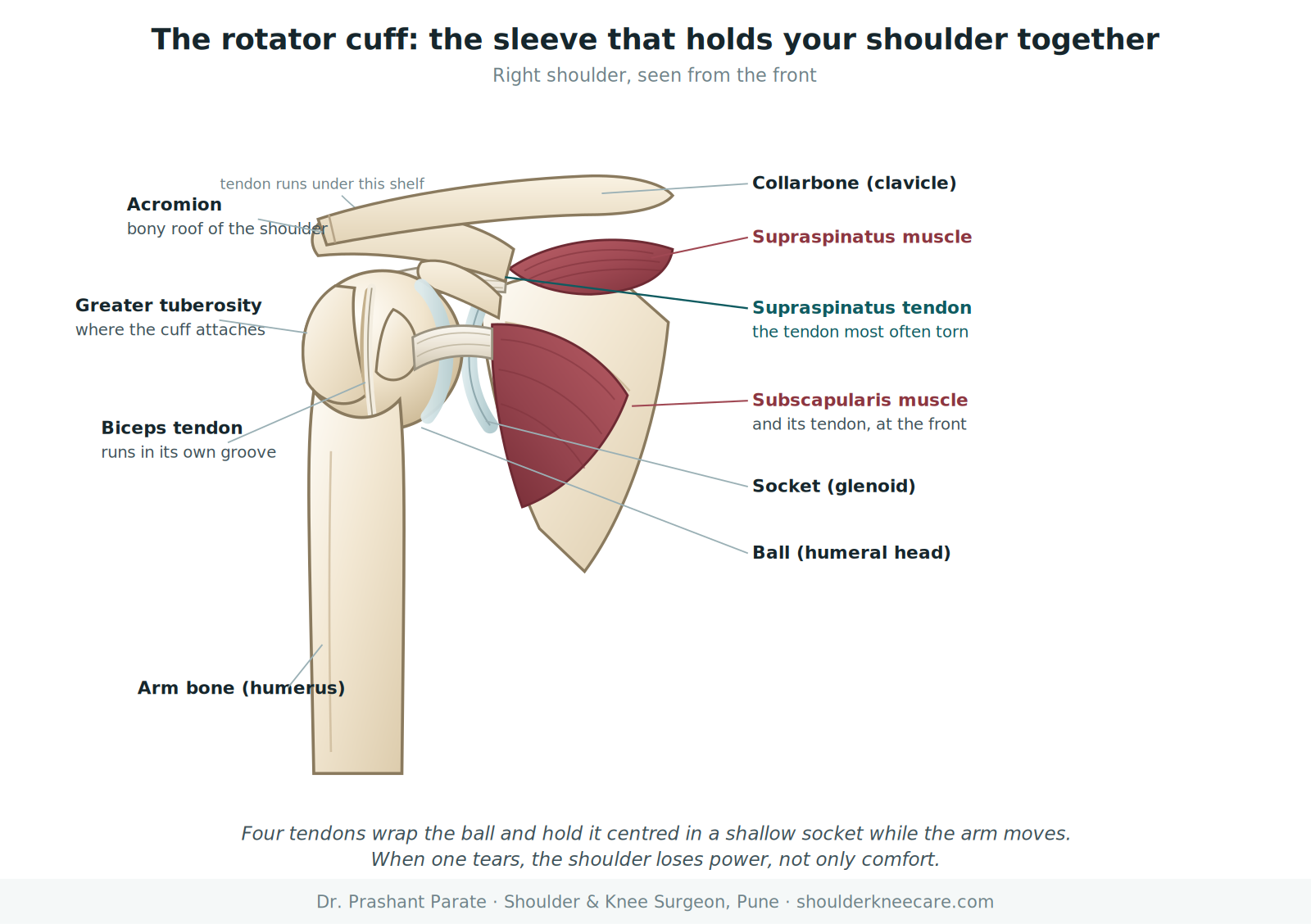
The rotator cuff is a sleeve of four tendons wrapping the ball of your shoulder: the supraspinatus on top, the subscapularis in front, and the infraspinatus and teres minor behind. Together they do two jobs: they keep the ball centred in its shallow socket, and they rotate and lift the arm.
The shoulder is the most mobile joint in the body, and it pays for that mobility with stability. The cuff is what supplies the missing stability. When one of these tendons tears, the shoulder loses both power and control, which is why a cuff tear causes weakness and not merely pain.
The single most useful distinction: stiff or weak?
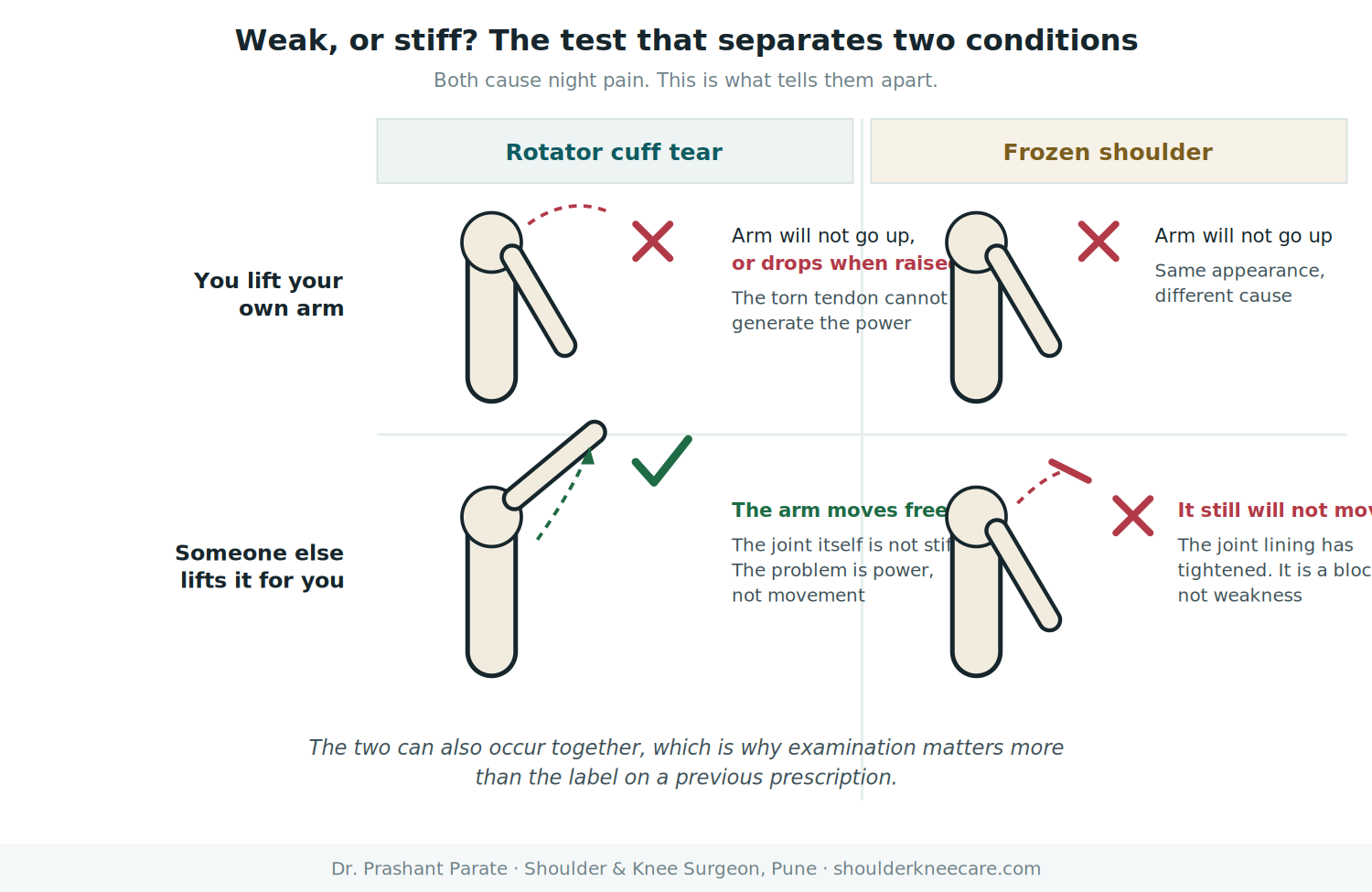
In India, almost every painful shoulder is labelled frozen shoulder, and many are treated as cervical spondylosis. The distinction is usually simple:
| Rotator cuff tear | Frozen shoulder | |
| Main problem | Weakness. You cannot lift the arm well | Stiffness. The shoulder will not move, even with help |
| If someone else lifts your arm | It usually moves reasonably well | It still will not move past a point |
| Typical trigger | A fall, a lift, or years of wear | Often no injury at all |
| Night pain | Common, worse lying on that side | Common as well, so this alone does not separate them |
Both can also coexist, which is exactly why a proper clinical examination matters more than the label on your previous prescription. If your neck movements do not reproduce the pain and your arm is weak rather than locked, cervical spondylosis is unlikely to be the whole story.
Why rotator cuff tears happen
Degenerative tears are the common variety after about 45. The tendon wears where its blood supply is poorest, sometimes helped along by a bony spur rubbing above it. These tears build slowly, and many people have one without knowing.
Traumatic tears follow a specific event: a fall on the outstretched hand, a two-wheeler accident, a heavy lift, or a sudden pull while holding a moving object. In a younger patient, a genuinely traumatic full-thickness tear is treated differently and more urgently than a degenerative one.
Risk rises with age, overhead work such as painting, construction, or teaching at a board, repeated overhead sport such as badminton, cricket bowling, or swimming, diabetes, and smoking. Diabetes matters twice over: it raises the risk of both cuff problems and shoulder stiffness, and it slows tendon healing after repair.
Symptoms
- Night pain, particularly when lying on the affected side. This is the classic symptom and the one that most often finally brings people in.
- Pain reaching overhead, or into a cupboard, or behind the back for a seatbelt or a saree pleat.
- Weakness lifting the arm, or a sense that the arm gives way while carrying something.
- A painful band in mid-range: fine at the bottom, painful in the middle, easier at the top.
- Cracking or catching with movement, and difficulty combing hair or hanging clothes.
How the diagnosis is made
Specific tests localise the tear before any scan does. Weakness with the arm out and thumb down suggests the supraspinatus; inability to hold the arm rotated outward suggests the infraspinatus; a positive belly press or a hand that cannot be lifted off the back suggests the subscapularis at the front. A drop arm sign, where the arm falls when released, points to a large tear.
X-rays check for spurs, arthritis, and the gap between the ball and the bone above it. Ultrasound in trained hands is a quick and inexpensive way to confirm a tear. MRI gives the full picture and is what we use for surgical planning.
Reading your MRI report
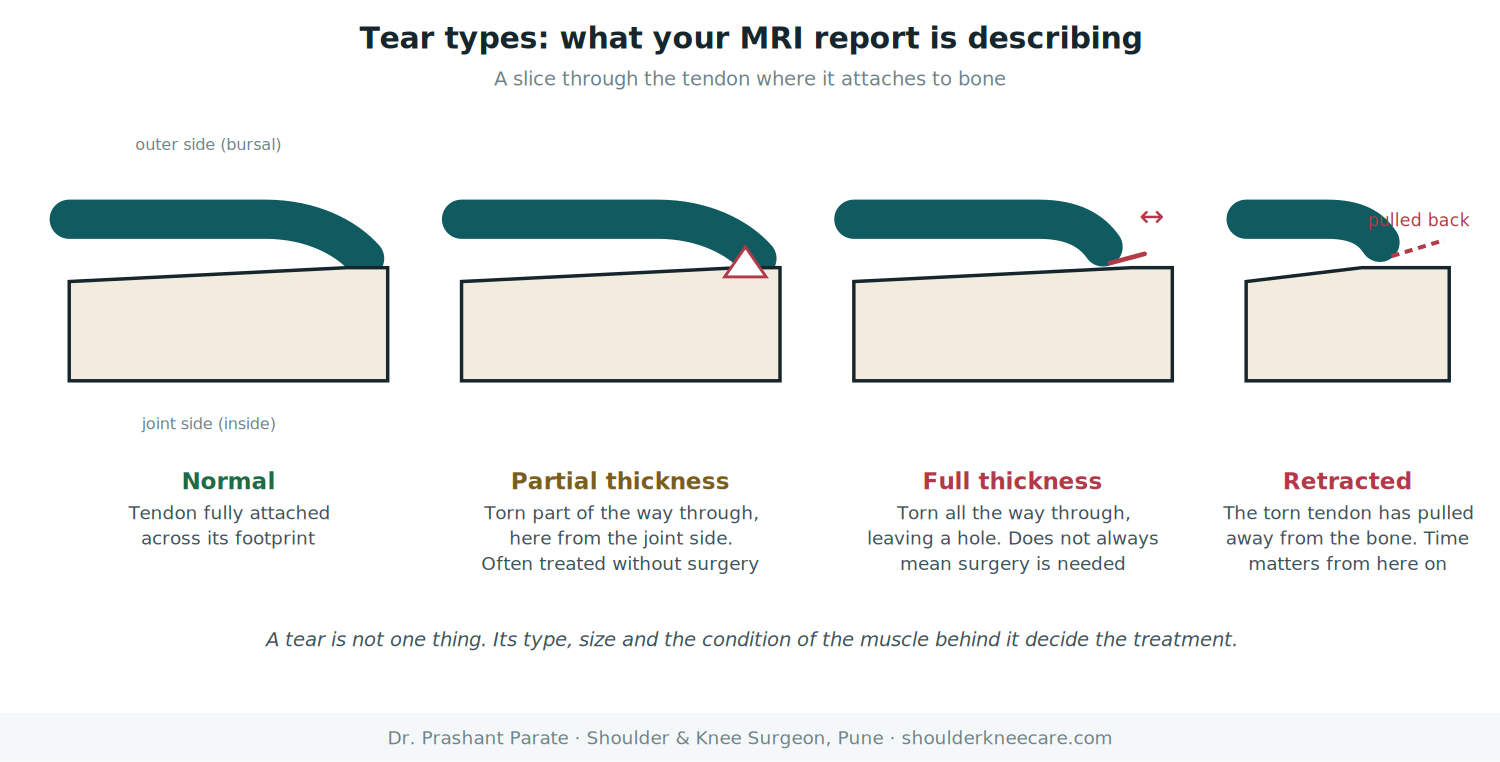
- Partial thickness: the tendon is torn part of the way through. Reports often say articular side (the joint side, more common) or bursal side.
- Full thickness: the tear goes all the way through, creating a hole. This does not automatically mean surgery.
- Size and retraction: how big the tear is and how far the tendon has pulled back.
- Fatty infiltration: whether the muscle has begun turning to fat. This is the finding that decides long-term outcome, because that change does not reverse.
The decision pathway: does your tear need surgery?
1. Is it a partial tear, with pain but no real weakness?
Start with a proper rehabilitation programme, not surgery. Most partial tears settle with targeted strengthening of the remaining cuff and the shoulder blade muscles, along with activity modification. Give it a genuine 3 months of supervised physiotherapy before considering an operation. Physiotherapy first.
2. Is it a full-thickness tear that followed a clear injury, in an active person?
This is the situation where waiting costs the most. A traumatic full-thickness tear tends to enlarge and retract, and the muscle begins its fatty change. Repairing it while the tissue is still healthy gives the best result of any cuff surgery. Repair, and do not postpone it.
3. Is it a degenerative full-thickness tear in an older, lower-demand shoulder that is coping?
Not every full-thickness tear must be repaired. If pain is controlled and function is acceptable after rehabilitation, continuing without surgery is a legitimate choice, with periodic review to make sure the tear is not progressing. Rehabilitate and monitor.
4. Have you done 3 months of correct physiotherapy and the night pain and weakness persist?
Then repair is reasonable and usually rewarding. The word correct matters: a few sessions of heat and ultrasound is not a trial of physiotherapy. A structured, progressive programme is. Proceed to repair.
5. Is the weakness increasing, or is a repeat scan showing the tear enlarging?
Do not keep waiting. Tear size and fatty muscle change are the two things that decide whether a repair will succeed, and both move in one direction only. This is the point at which a repairable tear starts becoming an unrepairable one. Act now rather than later.
If your tear is already very large or involves more than one tendon, the considerations are different, and I have written about that separately in the massive rotator cuff tear guide.
Treatment without surgery
Non-surgical treatment is not doing nothing. Done properly it means a progressive strengthening programme for the intact cuff and the shoulder blade muscles, correction of posture and technique, temporary avoidance of the movements that aggravate, and pain control so that you can actually exercise.
About steroid injections: a single well-placed injection can break a pain cycle and allow physiotherapy to begin, which is a legitimate use. Repeated injections into the same shoulder are a different matter, because steroid weakens tendon tissue and can make a later repair less likely to hold. If you have already had two or three injections and the pain keeps returning, the answer is a diagnosis, not another injection.
Surgical repair: what actually happens
Rotator cuff repair is done arthroscopically, through small keyhole portals. The frayed edges are cleared, the bone surface where the tendon attaches is prepared, and anchors placed in the bone carry sutures that hold the tendon down to that footprint while it heals. If a bone spur is rubbing above the tendon it is smoothed, and if the biceps tendon is a pain source it is dealt with in the same sitting.
Why the repair is only half the operation: the tendon has to heal to bone, and that is biology, not carpentry. It is why the rehabilitation protocol is not negotiable, why diabetes control and stopping smoking genuinely change your result, and why the tendon must sit on the bone without being pulled tight. A repair held under tension tends to fail quietly in the first few months.
Recovery timeline
| Stage | What happens |
| Week 0–6 | Sling protection. Assisted movements only, guided by your physiotherapist. Night pain usually starts settling in this period. |
| Week 6–12 | Sling off. Active movement begins, range returns gradually. Light daily activities and desk work resume. |
| Month 3–6 | Strengthening begins. This is when most patients notice the real change. Driving and most household work return. |
| Month 6–12 | Overhead sport and heavy manual work resume. The final result is judged at around a year. |
Two honest points. Pain relief arrives well before strength does, and patients who understand this in advance are far happier at the three month mark. And the commonest cause of a disappointing result is not the surgery but rehabilitation that was abandoned once the pain went.
Risks and complications
Stiffness is the most common issue after cuff repair and is usually managed with physiotherapy. Re-tear is a real risk, higher in larger tears, in diabetics, in smokers, and in patients who load the arm too early. Infection is uncommon in keyhole surgery. Some patients have temporary numbness around the portals. None of these are reasons to avoid surgery when it is indicated, but you should hear them before, not after.
What happens if a tear is left alone
Some tears stay stable for years, particularly small degenerative ones in low-demand shoulders, and those patients do fine. But a proportion enlarge. As the tear grows the tendon retracts, the muscle begins converting to fat, and eventually the ball of the shoulder starts riding upward. At that stage a straightforward repair is no longer possible, and the options become reconstruction or joint replacement. The purpose of monitoring is to catch movement in that direction early, while the choice is still yours.
Cost and insurance in Pune
Arthroscopic rotator cuff repair in Pune typically ranges between ₹1.5 and ₹3.5 lakh, depending on hospital category, the number of anchors needed, and room type. Most health insurance policies cover rotator cuff repair with cashless treatment at empanelled hospitals. If the tear followed a fall or accident, tell your insurer clearly, since accident-related claims are processed differently, and begin pre-authorisation several days before a planned date.
Indicative ranges, not quotations. An exact estimate is given after examination and imaging review.
Frequently asked questions
Can a rotator cuff tear heal on its own?
A torn tendon does not rejoin itself. What can change is the pain: with good rehabilitation, the surrounding muscles compensate and many people become comfortable and functional despite the tear. So the tear stays, but the problem may not.
I have had shoulder pain for two years. Is it too late?
Usually not, but it depends on what the MRI shows rather than on the calendar. If the muscle is still muscle and the tendon still reaches, repair remains a good option even after a long delay. If fatty change is advanced, the plan changes. This is worth checking rather than assuming.
Why is my shoulder worse at night?
Lying down removes the effect of gravity that holds the joint slightly apart during the day, and inflammation collects around the tendon at rest. Sleeping semi-upright with a pillow supporting the elbow helps many patients while treatment is being arranged.
Will I be able to sleep on that side again?
Yes, for most patients, though not immediately. Sleeping on the operated side is usually comfortable somewhere between two and four months after repair, and regaining that is often the change patients value most.
Does a bone spur have to be removed?
If a spur is genuinely rubbing the tendon it is smoothed during the same surgery. But removing a spur alone does not fix a torn tendon, and shoulder decompression by itself is no longer regarded as a solution for cuff tears.
Is PRP useful for a rotator cuff tear?
The honest answer is that the evidence for PRP as a treatment for an actual tear is weak. It is sometimes used alongside repair, and it has a clearer role in tendon inflammation than in a structural tear. It is not a substitute for repairing a tendon that needs repairing, and it should not be sold to you as one.
How long will I be off work?
Desk work is generally possible within two to three weeks with the arm protected, keeping in mind that driving takes longer. Manual and overhead work typically needs three to six months, which is worth planning before the surgery date rather than after it.
Both my shoulders have tears. Can they be done together?
No, and this is one situation where the answer is firm. You need one working arm during recovery. The second shoulder is addressed once the first has regained enough function, usually after three to six months.
Key takeaways
- Weakness suggests a cuff tear; stiffness suggests frozen shoulder. Getting this right early saves months.
- Not every tear needs surgery. Partial tears and many degenerative tears do well with proper rehabilitation.
- A traumatic full-thickness tear in an active patient should be repaired early rather than watched.
- Repeated steroid injections are not a treatment plan and can compromise a future repair.
- Fatty muscle change is permanent, which is why increasing weakness should be assessed and not tolerated.
Not sure whether it is your cuff, your neck, or a frozen shoulder?
One examination usually answers it. Bring any scans and reports you already have, and you will leave knowing what is torn, whether it needs repair, and what each option would realistically give you.
Appointments by phone
Sainath Hospital, Moshi, PCMC
86000 05886
Mon to Fri, 10 am to 4 pm · Sat, 10 am to 12 noon
Jupiter Hospital, Baner, Pune
020 2799 2150
Mon to Sat, 5.30 pm to 6.30 pm · OPD 5
All consultations by prior appointment. Timings may vary with the surgical schedule.
This page is patient education, not a substitute for consultation. Treatment decisions require clinical examination and imaging review. Last medically reviewed: July 2026 by Dr. Prashant Parate, DNB Orthopaedics, Fellowship in Arthroscopy & Sports Medicine (Thammasat University Hospital, Thailand).