KNEE · ACL INJURY GUIDE
Torn your ACL? Surgery isn’t always the answer, but the wrong delay can cost your knee.
Every week I meet patients who were told two opposite things: “you must operate immediately” and “just do physiotherapy, it will heal.” Both can be wrong. This guide explains how the decision is actually made, the same framework I use in my clinic.
Dr. Prashant Parate · Fellowship-trained Arthroscopy & Sports Injury Surgeon · Jupiter Hospital (Baner) & Sainath Hospital (Moshi, PCMC) · Reviewed July 2026
What the ACL does, and why a torn one doesn’t heal
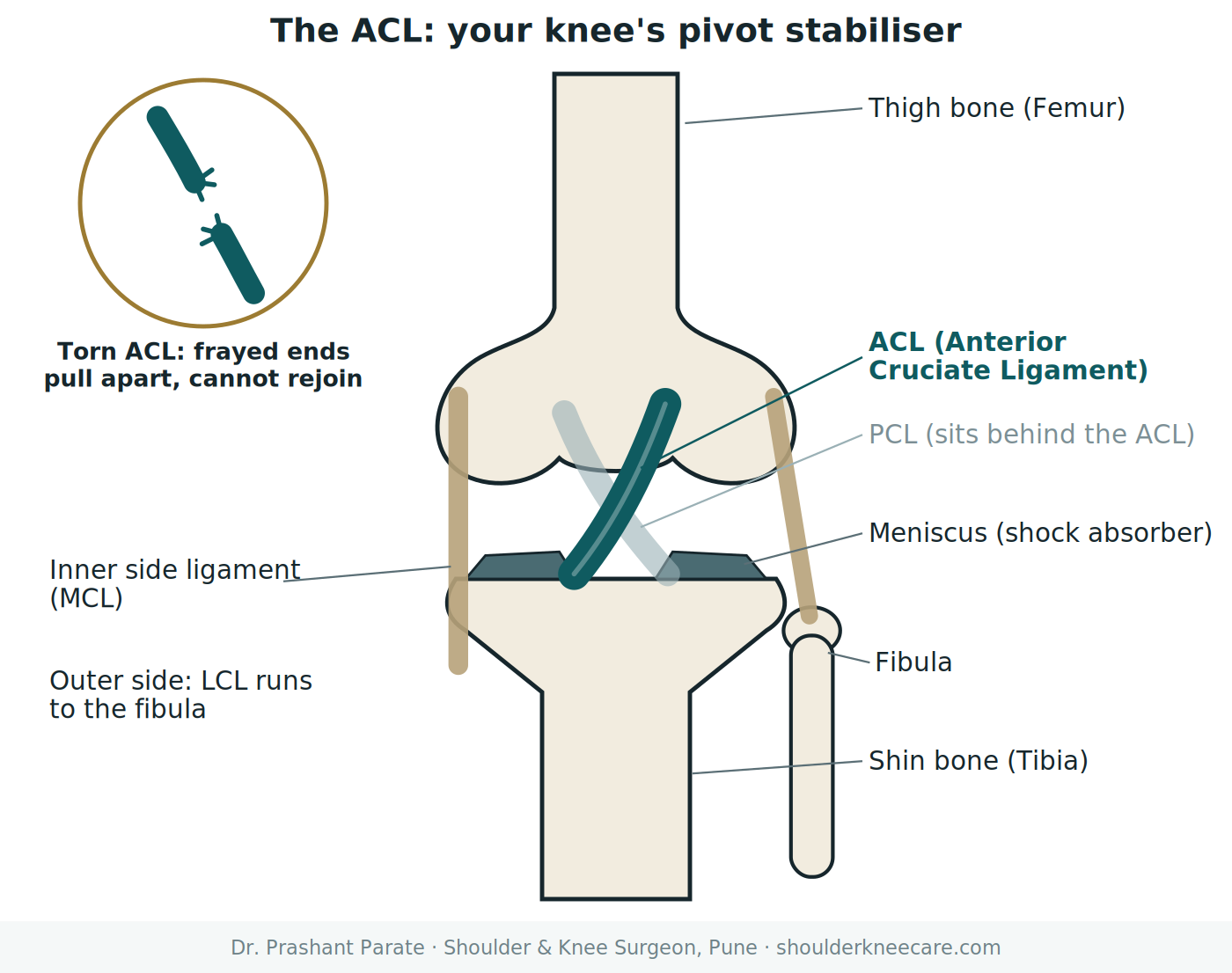
The anterior cruciate ligament is the central stabiliser of your knee. It stops the shin bone from sliding forward and controls rotation, every time you pivot, cut, land from a jump, or change direction, the ACL is working.
A completely torn ACL does not heal back to its original strength. It has poor blood supply, and its torn ends retract inside the joint. This is why treatment is not about “waiting for it to join”, it is about deciding whether your knee, for your life, needs the ligament rebuilt.
Typical injury story: a twisting fall in football, kabaddi, badminton, cricket fielding, or a two-wheeler accident. Many patients hear a “pop”, the knee swells within hours, and later it feels unreliable, a sensation of the knee giving way on stairs, uneven ground, or sudden turns.
Do you actually need ACL surgery? The 5-question decision pathway
Work through these five questions. They are the same ones I ask in the OPD, your answers point toward reconstruction or structured physiotherapy.
1. Does your knee give way during normal daily life or sport?
Instability is the single strongest indication. Every giving-way episode grinds the meniscus and cartilage, the knee’s shock absorbers. Repeated episodes significantly raise the risk of meniscus tears and early arthritis. Points toward surgery.
2. Do you play pivoting sports or have a physically demanding job?
Football, badminton, kabaddi, basketball, trekking, or work involving climbing, squatting, and uneven ground, these demand a stable knee. Desk-based, straight-line lifestyles tolerate an ACL-deficient knee far better. Active → surgery. Sedentary → trial of rehab.
3. Is there an associated meniscus or cartilage injury?
A repairable meniscus tear alongside an ACL tear is a strong reason to operate, repairing the meniscus early preserves the knee for decades, and the repair heals best when done with ACL reconstruction. Points toward surgery, often sooner. See combined ACL and meniscus surgery.
4. What is your age and activity level, honestly?
Age itself is not the criterion; demand is. A 48-year-old trekker may need reconstruction; a 26-year-old with a desk job and no sport may cope well without it. Some patients (“copers”) stabilise their knee with dedicated strength training alone. Low demand → structured physiotherapy first.
5. Is it a partial tear with a stable knee?
Some partial tears with no instability on examination do well with 8–12 weeks of supervised rehabilitation. The key is re-examination, if instability appears, the plan changes. Trial of rehab, with review.
The honest summary: young or active patients with instability, and anyone with a repairable meniscus tear, usually benefit from reconstruction. Older, low-demand patients with stable knees deserve a genuine trial of physiotherapy, not reflex surgery.
How ACL reconstruction works, and choosing your graft
ACL reconstruction is keyhole (arthroscopic) surgery. Through two small portals, the torn ligament is replaced with a graft, a tendon taken from your own body, anchored in bone tunnels positioned to reproduce your original anatomy. Most patients stay one night in hospital and walk with support the next day.
| Graft | Strengths | Considerations | Often chosen for |
| Hamstring tendon | Small incision, less kneeling pain, reliable results | Mild early hamstring weakness | Most patients; those who kneel, squat, sit cross-legged |
| BPTB (patellar tendon) | Bone-to-bone healing, strong fixation | Kneeling discomfort in some patients | High-level pivoting athletes |
| Quadriceps tendon | Thick, robust graft; growing evidence base | Newer technique, surgeon-dependent | Revision cases, larger builds |
| Peroneus longus tendon | Consistently thick graft; spares the knee’s own muscles, so hamstring strength is preserved | Harvested from the ankle, mild, usually temporary effect on ankle strength; long-term data still growing | Thin hamstring tendons, revision surgery, athletes who depend on hamstring power |
| Allograft (donor tendon) | No donor-site pain, shorter surgery time | Slower graft incorporation, higher re-tear risk in young athletes, cost and limited tissue-bank availability in India | Revision and multi-ligament reconstruction, older patients |
| Synthetic ligament (e.g., LARS) | No graft harvest, immediate strength | Long-term failure and inflammation concerns; not a first choice for primary ACL in young patients | Select, uncommon situations only |
There is no universally “best” graft, the right choice depends on your sport, occupation, kneeling and floor-sitting requirements, and anatomy. We decide it together during consultation. For a full explanation of each option and how the choice is made for your knee, see ACL graft selection: which graft is right for me.
The realistic ACL recovery timeline
Surgery is one day. Recovery is a nine-to-twelve-month project, and rehabilitation quality decides your result as much as surgical technique does.
| Stage | What happens |
| Week 0–2 | Walk with support from day one. Pain control, swelling management, quadriceps activation, achieving full knee straightening. |
| Week 2–6 | Back to desk work by week 2–3. Progressive bending, stationary cycling, wean off crutches as strength allows. |
| Week 6–12 | Driving by week 6–8. Gym-based strengthening, balance work. Full bend regained, cross-legged sitting and squatting return around month 3–4, because your natural joint is preserved. |
| Month 3–6 | Jogging begins around month 3–4 once strength criteria are met. Sport-specific drills introduced gradually. |
| Month 6–9 | Agility, cutting and jumping training. Strength testing comparing the operated leg with the healthy side. |
| Month 9–12 | Return to competitive sport, after passing return-to-sport testing, not just a calendar date. Returning early is the single biggest re-tear risk. |
What ACL surgery costs in Pune, and what insurance covers
In Pune, ACL reconstruction typically ranges between ₹1.5 and ₹3.5 lakh, depending on the hospital category, implants and graft fixation devices used, room type, and whether additional procedures (such as meniscus repair) are needed in the same sitting.
Most health insurance policies cover ACL reconstruction, including cashless treatment at empanelled hospitals. Two practical points patients often miss: inform your insurer that the injury is traumatic (accident-related claims are processed differently from degenerative conditions), and get pre-authorisation initiated a few days before a planned surgery date.
Figures are indicative ranges, not quotations. An exact estimate is given after clinical assessment and MRI review, and the hospital’s insurance desk assists with cashless approval.
ACL surgery, frequently asked questions
Can an ACL tear heal without surgery?
A complete tear does not heal to original strength, the ligament has poor blood supply. But “no healing” does not automatically mean “needs surgery.” Low-demand patients with stable knees, and some partial tears, do well with structured physiotherapy. The decision pathway above explains how we separate the two groups.
What happens if I delay surgery in an unstable knee?
Each giving-way episode risks tearing the meniscus and damaging cartilage. Delaying reconstruction in unstable knees is associated with significantly higher rates of meniscus injury, raising the long-term risk of early arthritis. Instability, not the calendar, is the warning sign.
Can I sit cross-legged and squat after ACL reconstruction?
Yes. Unlike knee replacement, ACL reconstruction preserves your natural joint. Once full bend is regained in rehabilitation, usually by month 3–4, cross-legged sitting, squatting, and using an Indian toilet are comfortable for most patients.
How painful is the surgery, and how long in hospital?
ACL reconstruction is keyhole surgery done under spinal or general anaesthesia. Most patients stay one night, walk with a brace and support the next morning, and manage pain well with routine medication for the first week or two.
Will I need a second surgery to remove implants?
No. The buttons and screws used for graft fixation are designed to stay permanently and almost never need removal. They do not set off airport metal detectors in most cases and do not interfere with MRI scans.
What is the re-tear risk?
Overall re-tear rates are low, but the risk concentrates in young athletes who return to pivoting sport early. This is exactly why we insist on return-to-sport testing at 9–12 months rather than a fixed date, passing strength and hop tests, not impatience, decides the return.
Is robotic surgery used for ACL reconstruction?
Robotics currently applies to joint replacement, not ACL reconstruction. ACL surgery is arthroscopic, precision comes from anatomic tunnel placement under direct camera vision, which is a matter of surgical training and technique.
Not sure which side of the pathway you’re on?
Bring your MRI. In one consultation we’ll examine the knee, review the scan together, and give you a clear, honest answer, surgery, rehabilitation, or watchful waiting.
Appointments by phone
Sainath Hospital, Moshi, PCMC
86000 05886
Mon to Fri, 10 am to 4 pm · Sat, 10 am to 12 noon
Jupiter Hospital, Baner, Pune
020 2799 2150
Mon to Sat, 5.30 pm to 6.30 pm · OPD 5
All consultations by prior appointment. Timings may vary with the surgical schedule.
This page is patient education, not a substitute for consultation. Treatment decisions require clinical examination and imaging review. Last medically reviewed: July 2026 by Dr. Prashant Parate, DNB Orthopaedics, Fellowship in Arthroscopy & Sports Medicine (Thammasat University Hospital, Thailand).