KNEE · ROBOTIC KNEE REPLACEMENT
Robotic knee replacement: what actually changes, and what the marketing overstates.
Robotic assistance is heavily advertised in Pune, and patients are often told it is simply better. The truthful position is more interesting. The robot measurably improves one thing, does not perform the surgery, and has not yet been shown to change how satisfied patients feel years later. Here is what it does, what it costs, and who genuinely benefits.
Dr. Prashant Parate · Shoulder, Knee & Sports Injury Surgeon · In orthopaedic practice since 2010, DNB-qualified since 2012 · Jupiter Hospital (Baner) & Sainath Hospital (Moshi, PCMC) · Reviewed July 2026
Related: Total Knee Replacement: Complete Guide and Knee Arthritis
The robot does not operate on you
This is the first misconception to clear. No robot performs a knee replacement. There is no machine making decisions and no surgeon standing aside watching.
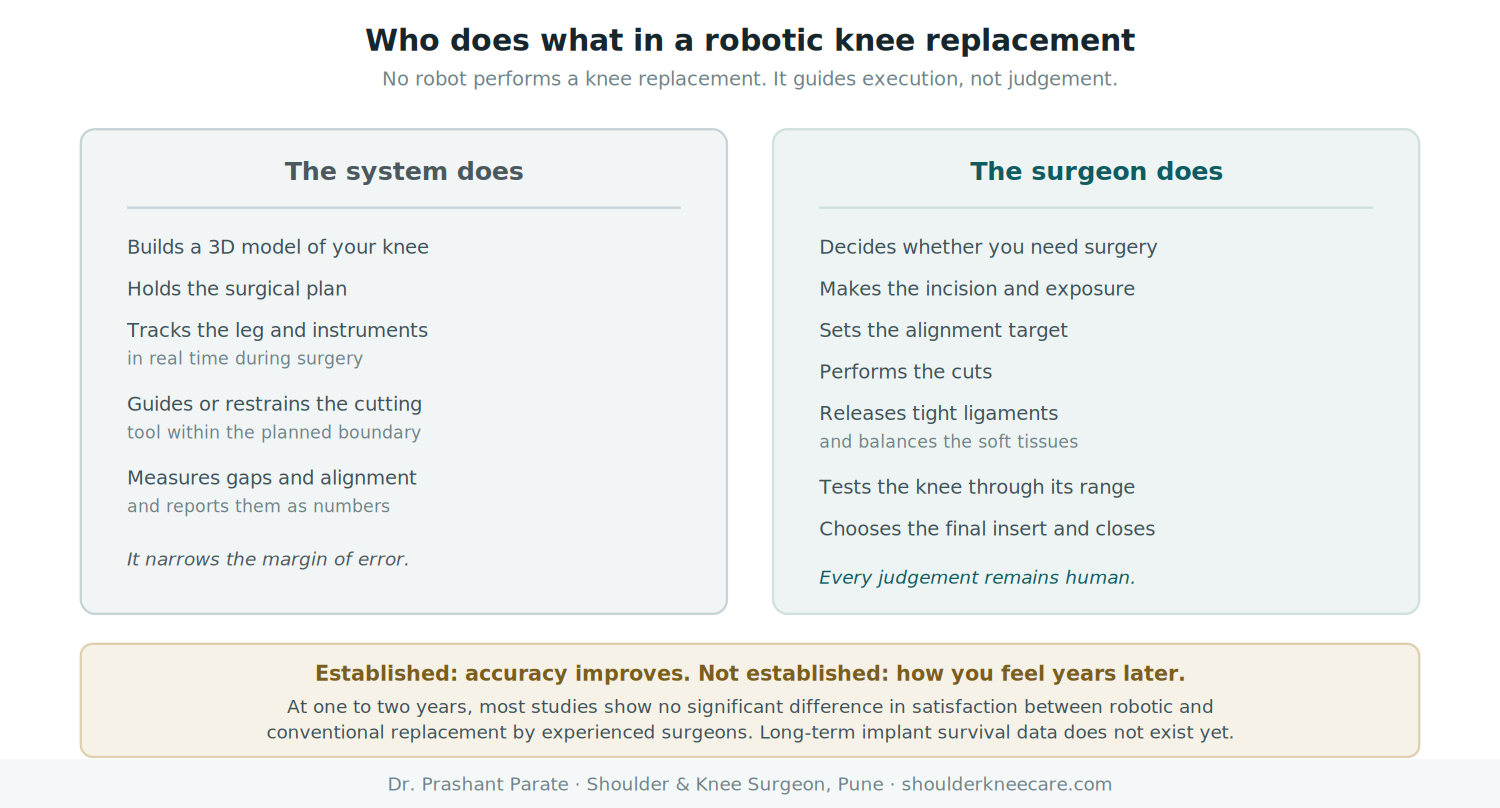
What these systems provide is planning and control. Before or during surgery, a three-dimensional model of your knee is built. The surgeon plans the position and size of the implants and the alignment of the limb on that model. During surgery, the system tracks the position of your leg and the instruments in real time, and either guides the cutting tool or physically restrains it from straying outside the planned boundary.
The surgeon still makes the incision, exposes the joint, makes every judgement about alignment and ligament balance, performs the cuts, releases tight tissues, tests the knee through its range, chooses the final insert thickness, and closes. The robot narrows the margin of error on execution. It does not supply the judgement.
The three kinds of system, since they are not the same
| Type | How it works | Trade-off |
| CT-based | A CT scan before surgery builds a precise model of your anatomy for planning | Most detailed planning, but requires an extra scan and its radiation dose |
| Imageless | The model is built in theatre by mapping points on your bone directly | No extra scan, slightly less pre-operative detail |
| Handheld guided | A smaller instrument that controls the cutting tool without a large robotic arm | Less theatre footprint, similar principle |
If a hospital quotes you for robotic surgery, it is reasonable to ask which system, and whether a pre-operative CT is included in the price or billed separately.
What the evidence actually shows
This is where honest reporting matters, because the gap between what is proven and what is advertised is wide.
Established: accuracy improves
Robotic assistance reliably produces implant positioning and limb alignment closer to the surgical plan, with fewer outliers. This is consistently demonstrated and is not in dispute.
Mixed: early recovery
Some studies report modestly less early pain and a slightly faster initial recovery, attributed to reduced soft tissue disturbance. Other studies show no meaningful difference. If the benefit exists, it is small and short-lived.
Not established: how you feel years later
At one to two years, most comparative studies show no significant difference in patient-reported satisfaction or function between robotic and conventional replacement performed by experienced surgeons. And because the technology is relatively recent, we do not yet have the twenty-year implant survival data that would tell us whether better accuracy translates into implants lasting longer. It is a reasonable expectation. It is not yet a proven fact.
So the fair summary is this. Robotic assistance makes the operation more precise. Whether that precision changes your life ten years from now is a plausible hypothesis awaiting evidence. Anyone telling you it is definitively superior is going beyond what is currently known, and anyone dismissing it as a gimmick is ignoring a real improvement in accuracy.
Who is most likely to benefit
Precision matters more in some knees than others. The situations where robotic assistance has the strongest rationale:
- Significant deformity, a markedly bow-legged or knock-kneed limb, where the correction is larger and the margin for error smaller.
- Unusual anatomy, or previous surgery, fracture or hardware that distorts the normal landmarks used in conventional technique.
- Partial knee replacement, where component positioning is more demanding and small errors matter more than in a total replacement.
- Younger patients, where the implant must last longer and any accuracy advantage has more years in which to matter.
Conversely, a straightforward arthritic knee with modest deformity, operated by an experienced surgeon using conventional instruments, is very likely to get an excellent result either way. That is not a criticism of robotics. It is a statement about where the marginal gain sits.
What it costs, and what insurance does
Robotic assistance typically adds ₹50,000 to ₹1.5 lakh to the cost of a knee replacement in Pune, depending on hospital and system. If a pre-operative CT is required, that is an additional charge.
Insurance frequently does not cover the robotic surcharge, even when it covers the replacement itself, because many policies treat it as a technology upgrade rather than a medical necessity. Some corporate policies do cover it. This is worth confirming with your insurer specifically, in writing, before you commit, rather than discovering it at discharge.
The honest framing of the money question: you are paying for improved accuracy of execution, with a reasonable expectation of long-term benefit that has not yet been proven. If the cost is comfortable for you, it is a defensible choice. If it means straining finances or delaying surgery you need, a conventional replacement done well is a perfectly good operation and you should not feel you are settling.
What robotics does not change
Several things are identical whichever route you take, and they matter more than the technology.
- Whether you need a replacement at all. That decision is unchanged, and it is the more important one.
- Your rehabilitation, which is the same programme and the same effort, and which affects your result more than the cutting method.
- Squatting and cross-legged sitting, which remain limited afterwards. Robotics does not change this, and it is sometimes implied that it does.
- Infection risk, clot risk and the general risks of surgery.
- The surgeon’s judgement and experience, which remain the largest single variable in your outcome.
Frequently asked questions
Is robotic knee replacement safer?
Overall complication rates are broadly similar. The accuracy advantage reduces the chance of a poorly positioned implant, which is one cause of later problems, but robotic surgery is not a materially safer operation in terms of infection, clots or anaesthetic risk. The safety profile is essentially the same.
Does it hurt less or recover faster?
The evidence is mixed. Some studies show a modest early advantage in the first few weeks, others show none. By three months the difference disappears in essentially every study. If you are choosing robotics primarily for a faster recovery, the evidence does not strongly support that expectation.
Will a robotic knee last longer?
Plausibly, but it is not yet proven. Better alignment is associated with better long-term survival in older data, so the reasoning is sound. However, robotic systems have not been in use long enough to produce fifteen and twenty year survival comparisons. Anyone stating this as established fact is ahead of the evidence.
Does the surgery take longer?
Modestly, particularly early in a surgeon’s experience with the system, mostly due to setup and registration. Experienced users approach conventional operating times. A slightly longer procedure is not in itself a problem.
If I cannot afford robotic surgery, am I getting a lesser operation?
No, and this deserves a direct answer because the marketing can make patients feel that way. Conventional knee replacement performed by an experienced surgeon is a highly successful, well-established operation with decades of excellent results behind it. The vast majority of successful knee replacements worldwide were done conventionally. You are not settling.
Should I choose the hospital with the robot, or the surgeon?
The surgeon. Technology in unfamiliar hands does not beat experience with familiar instruments. If you can have both, that is ideal. If you must choose, choose the surgeon whose judgement you trust and who explains the decision rather than sells the machine.
Is robotic partial knee replacement different?
The rationale is stronger there. Partial replacement is technically more demanding in terms of component positioning, and small errors have larger consequences, so the accuracy benefit has more to work with. If a partial replacement is the plan, robotic assistance is a more compelling proposition than it is for a routine total replacement.
Key takeaways
- The robot guides, the surgeon operates. Every judgement remains human.
- Accuracy is genuinely better. That much is established.
- Satisfaction at one to two years is largely the same, and long-term survival data does not exist yet.
- The strongest case is severe deformity, distorted anatomy, partial replacement, and younger patients.
- The surcharge is often not covered by insurance. Confirm in writing beforehand.
- Choose the surgeon before the technology. A conventional replacement done well is not a compromise.
Weighing up robotic against conventional?
Bring your standing X-rays. You will get a straight answer about whether your particular knee is one where the accuracy advantage is likely to matter, and whether the extra cost is worth it in your case.
Appointments by phone
Sainath Hospital, Moshi, PCMC
86000 05886
Mon to Fri, 10 am to 4 pm · Sat, 10 am to 12 noon
Jupiter Hospital, Baner, Pune
020 2799 2150
Mon to Sat, 5.30 pm to 6.30 pm · OPD 5
All consultations by prior appointment. Timings may vary with the surgical schedule.
This page is patient education, not a substitute for consultation. Treatment decisions require clinical examination and imaging review. Last medically reviewed: July 2026 by Dr. Prashant Parate, DNB Orthopaedics, Fellowship in Arthroscopy & Sports Medicine (Thammasat University Hospital, Thailand). MMC Reg. 2006042129.