Knee · ACL Reconstruction Guide
ACL Graft Selection: Which Graft Is Right for Me?
If you need ACL reconstruction, one of the important decisions is which graft should be used to reconstruct the ligament. Patients often ask: “Which is the best graft for ACL surgery?”
There is no single graft that is best for everyone. Hamstring, peroneus longus, patellar tendon, quadriceps tendon, allograft and synthetic grafts can all have a role in ACL reconstruction. The appropriate choice depends on the individual patient, the knee, activity demands and the type of reconstruction required.
The aim is therefore not simply to choose the “strongest” graft. The aim is to choose the most appropriate graft for you.
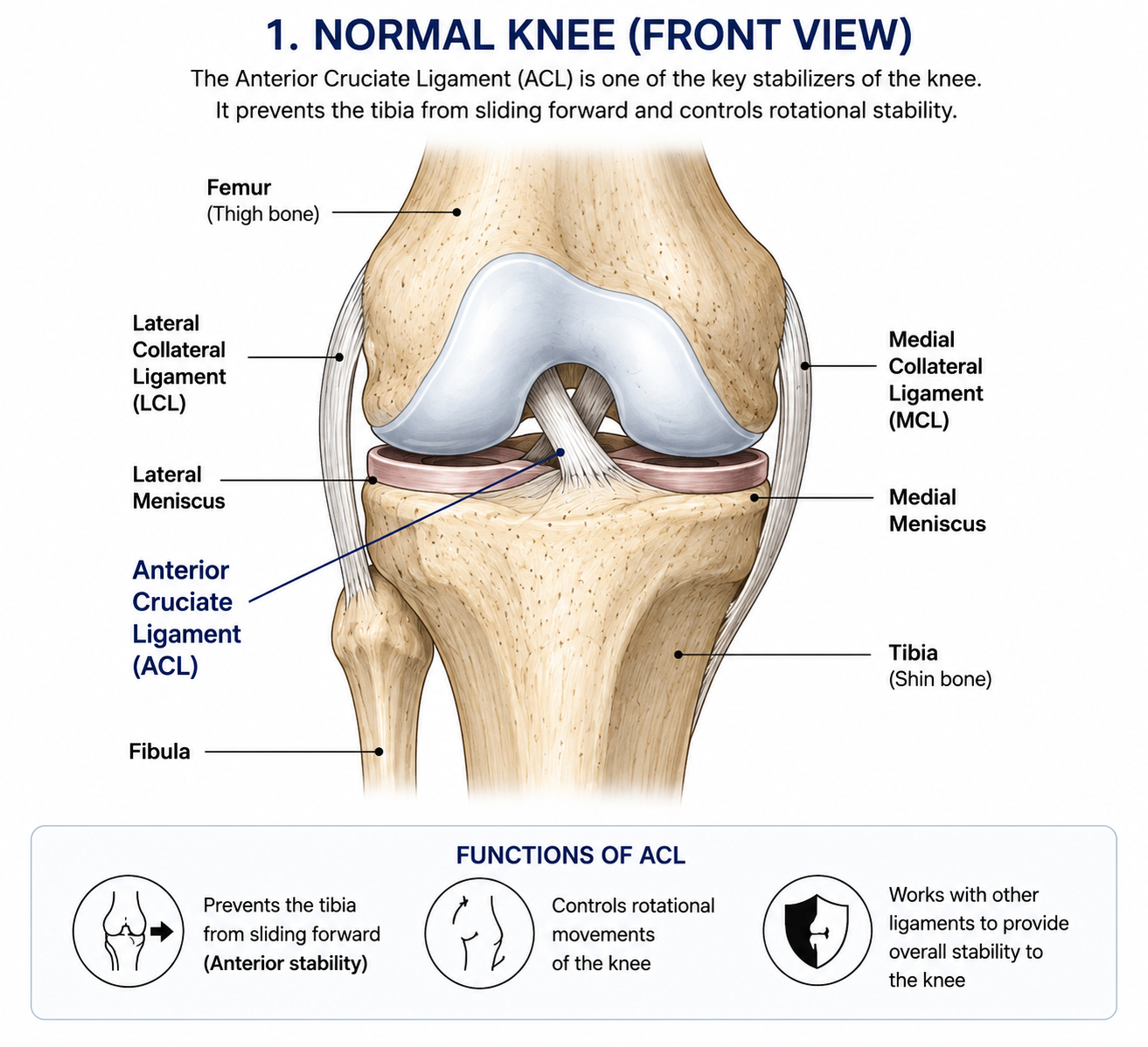
What Does an ACL Graft Actually Do?
The ACL is one of the major stabilizing ligaments inside the knee. It helps control abnormal forward movement and rotation of the tibia relative to the femur.
Not every ACL injury requires surgery. However, when ACL reconstruction is indicated, a graft is positioned in the anatomical location of the ACL and fixed to the femur and tibia to restore functional stability.
A successful reconstruction depends on much more than simply choosing a graft. The graft needs to:
- have adequate size and strength
- be positioned correctly
- achieve secure fixation
- incorporate appropriately
- work together with the other stabilizing structures of the knee
Associated meniscus injuries, cartilage damage, other ligament injuries, limb alignment and rehabilitation can all influence the final outcome.
Where Does an ACL Graft Come From?
ACL grafts can broadly be divided into three groups.
Autograft. Tissue taken from the patient’s own body. Common options include the hamstring tendon, peroneus longus tendon, bone-patellar tendon-bone (BPTB) and quadriceps tendon.
Allograft. Tissue obtained from a screened donor through a tissue bank.
Synthetic graft. A manufactured ligament designed for ligament reconstruction.
Each option has advantages and limitations.
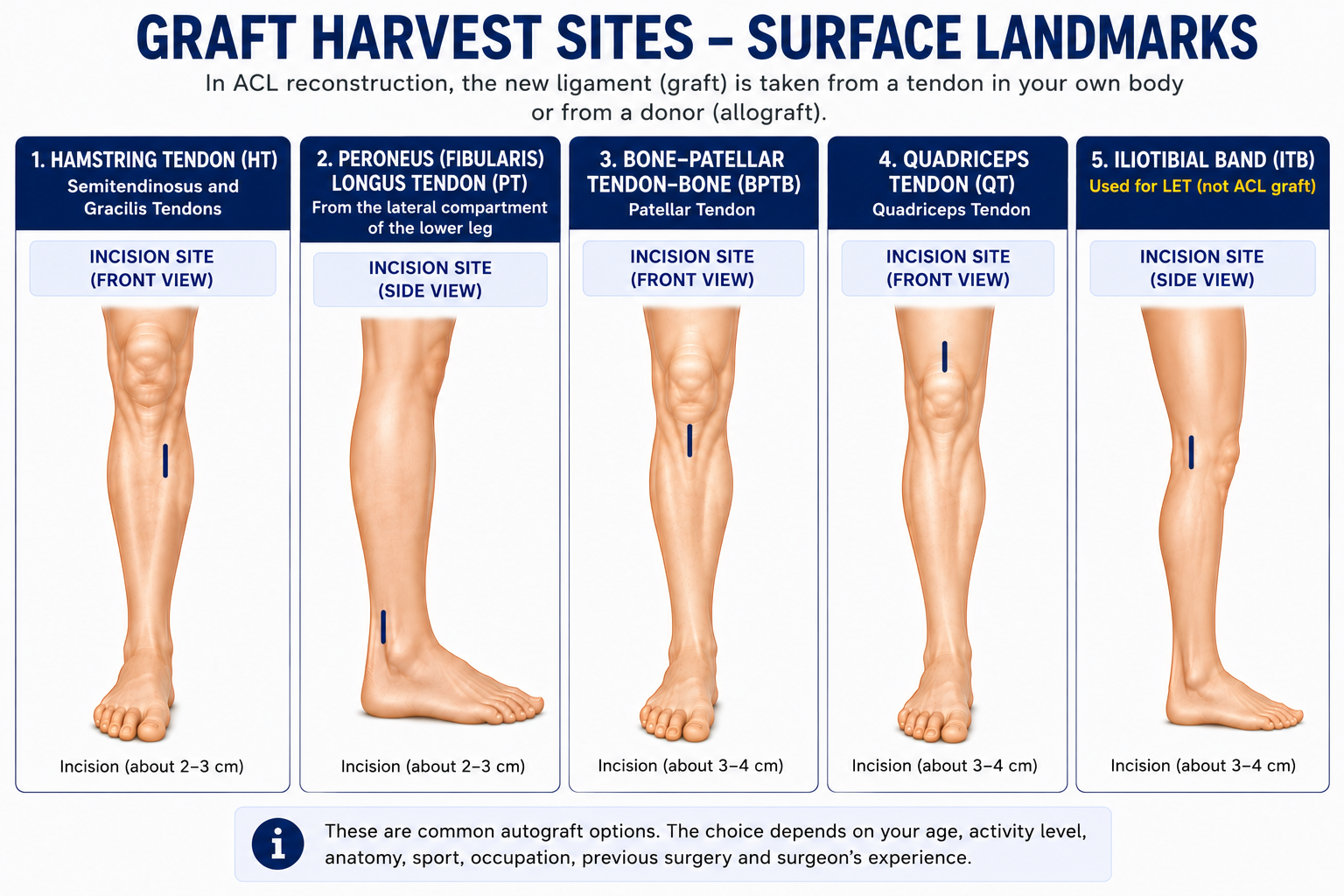
The iliotibial band shown in this diagram is generally used for lateral extra-articular tenodesis (LET). It is not one of the routine ACL graft choices.
1. Hamstring Tendon Graft
The hamstring tendon remains one of the most commonly used grafts for ACL reconstruction. The harvested tendon can be folded several times to create a strong multi-strand graft. Depending on the tendon and preparation technique, it may be prepared as a 6-fold or sometimes 8-fold graft.
Advantages
- One of the most established ACL autografts
- Suitable for a broad range of primary ACL reconstructions
- Relatively small harvest incision
- No bone needs to be harvested
- Generally less kneeling discomfort than BPTB
- Can provide a strong multi-strand graft
What needs to be considered?
Hamstring tendon size varies between individuals. In some patients, particularly shorter individuals and some female patients, the available hamstring tendon may be smaller than desired. Harvesting the tendon can also cause some hamstring weakness during recovery. For many patients undergoing their first ACL reconstruction, however, hamstring remains an excellent graft option.
2. Peroneus Longus Tendon Graft
The peroneus longus tendon is becoming an increasingly used ACL graft option. It provides a good length of tendon and can produce a substantial graft while preserving the hamstrings. It is commonly prepared as a 4-fold graft.
When can peroneus longus be particularly useful?
It can be considered when:
- a smaller hamstring graft is anticipated
- the patient is relatively short or has smaller hamstring tendons
- preserving the hamstrings is desirable
- an alternative autograft is required
- a previous ACL reconstruction has already used the hamstring tendons
- revision ACL reconstruction is possible without major tunnel problems
- multiple grafts are required
Peroneus longus is also useful as a graft option in PCL reconstruction and selected multiligament knee reconstructions.
What needs to be considered?
Because the tendon is harvested from the lower leg, potential effects at the ankle and donor site should be considered. Appropriate harvesting technique and patient selection are important.
3. Bone-Patellar Tendon-Bone (BPTB) Graft
A BPTB graft consists of the central portion of the patellar tendon with a small bone block at each end. This allows bone-to-bone healing inside the femoral and tibial tunnels. BPTB was historically used very commonly for primary ACL reconstruction. Today, graft-selection practices have evolved, but BPTB remains an important option.
When can BPTB be useful?
It is particularly valuable in selected revision ACL reconstructions. Some surgeons also continue to prefer BPTB for high-demand athletes, contact sports, pivoting sports, and situations where bone-to-bone healing is considered advantageous.
Advantages
- Long clinical track record
- Strong fixation possibilities
- Bone-to-bone healing
- Important revision graft option
What needs to be considered?
Potential donor-site problems include pain at the front of the knee, discomfort while kneeling, symptoms around the patellar tendon harvest site, and temporary quadriceps weakness. Kneeling discomfort can be particularly relevant for patients whose occupation or lifestyle requires frequent kneeling.
4. Quadriceps Tendon Graft
The quadriceps tendon has become an increasingly important graft for ACL reconstruction. It provides a thick and robust graft and is useful in both primary and revision situations. A central quadriceps graft can be harvested without bone as an all-soft-tissue graft, or with a bone block on one side. This gives the surgeon considerable flexibility.
When can quadriceps tendon be useful?
It may be considered for:
- primary ACL reconstruction
- revision ACL reconstruction
- patients in whom a large, robust graft is desirable
- situations where another graft has already been harvested
- patients in whom BPTB would otherwise be considered
It therefore provides an important alternative to BPTB, particularly in selected primary and revision reconstructions.
What needs to be considered?
Because the graft comes from the quadriceps mechanism, temporary quadriceps weakness and donor-site discomfort can occur. Appropriate quadriceps rehabilitation is therefore important.
How Do the Main ACL Grafts Compare?
There is more to graft selection than simply comparing the theoretical strength of different tendons. Important differences include graft source, available graft size, healing characteristics, donor-site morbidity, previous graft harvest, primary versus revision surgery, associated ligament injuries, and sport and activity requirements.
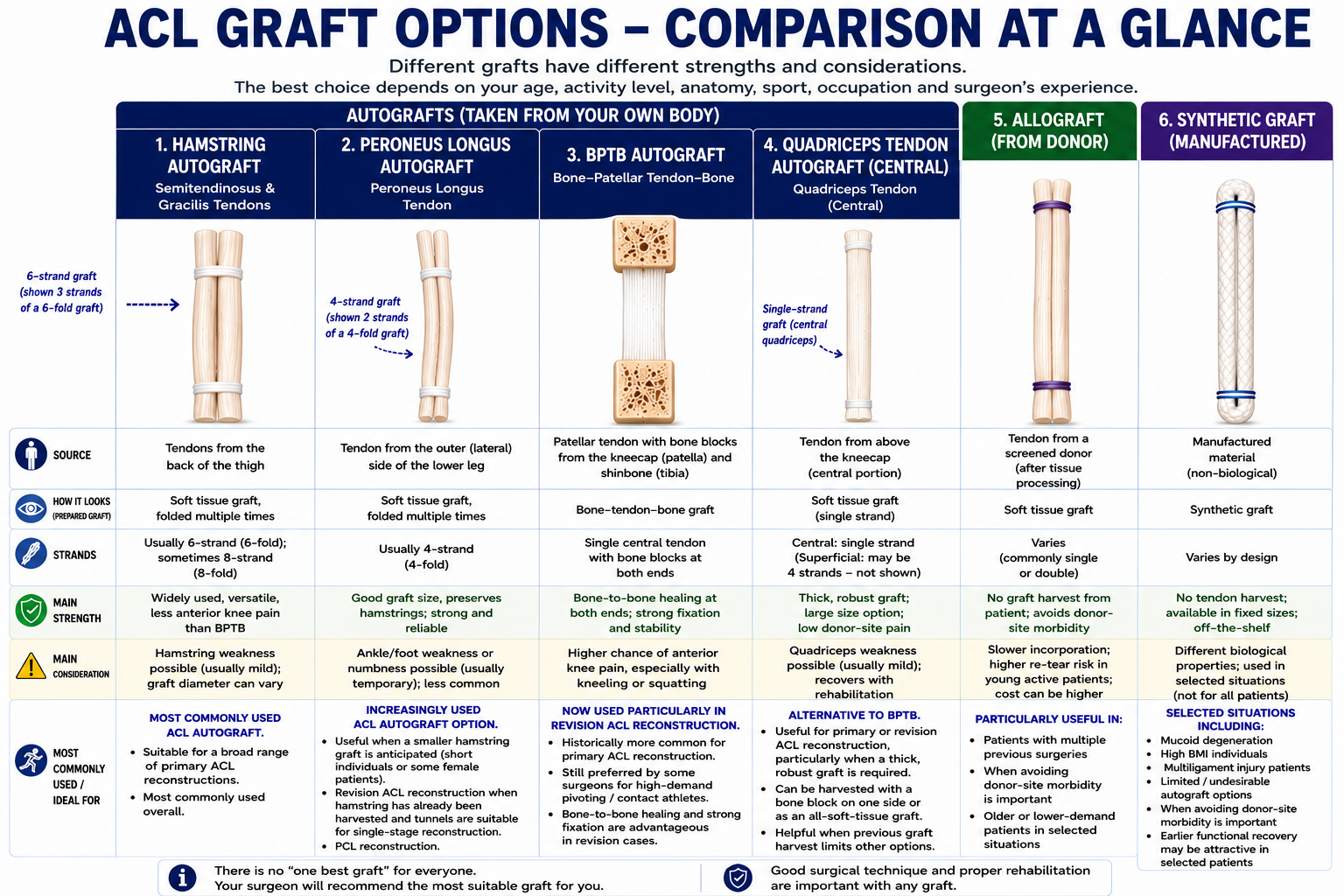
The comparison provides a useful overview, but the final choice still needs to be individualized.
5. Allograft: Donor Tissue
An allograft is suitable graft tissue obtained from a screened donor rather than harvested from the patient’s own body. Its major advantage is straightforward: another tendon does not need to be harvested from the patient.
Advantages
- Avoids additional autograft harvest
- Avoids donor-site morbidity from taking another tendon
- Provides additional graft options when the patient’s own graft sources are limited
- Can be useful when several grafts are required
When can allograft be particularly useful?
Allograft becomes especially valuable in patients who have undergone multiple previous ligament surgeries, complex revision reconstruction, multiligament knee injuries, situations where available autografts are limited, and patients in whom avoiding additional donor-site morbidity is particularly important.
Is an allograft suitable for everyone?
No. Patient age, activity level, graft processing and the demands placed on the reconstruction all matter. In particular, allograft use in young, highly active patients needs careful consideration, because incorporation and failure risk may differ from appropriately selected autografts. Allograft is therefore an important option, but not automatically a better option simply because no tendon needs to be harvested.
6. Synthetic ACL Grafts
A synthetic graft is a manufactured ligament rather than a tendon harvested from the patient or obtained from a donor. Modern synthetic ligament systems should not be confused with biological autografts, allografts or internal-brace augmentation. These are different reconstructive strategies.
Synthetic grafts are not required for routine ACL reconstruction in every patient. They can, however, provide another useful option in selected situations.
When may a synthetic graft be considered?
Depending on the patient and the reconstruction required, selected situations may include:
- mucoid degeneration of the ACL
- high-BMI individuals
- multiligament knee injuries
- situations where multiple grafts are required
- limited or undesirable autograft options
- patients in whom avoiding donor-site morbidity is particularly important
- selected situations where earlier functional recovery is an important consideration
Synthetic grafts should therefore be viewed as another tool available for selected patients, rather than as a replacement for autografts in every ACL reconstruction.
Does a synthetic graft mean faster return to sport?
Not necessarily. Avoiding tendon harvest may influence early recovery in selected patients, but safe return to sport cannot be decided by graft type alone. It also depends on associated meniscus or cartilage procedures, knee stability, muscle strength, neuromuscular control, rehabilitation, functional testing and the overall reconstruction performed. A patient should therefore not choose a synthetic graft simply because of a promise of faster return to sport.
Autograft vs Allograft vs Synthetic: Which Is Better?
There is no universal winner.
Autograft uses the patient’s own biological tissue and remains the mainstay of ACL reconstruction for many patients.
Allograft avoids another tendon harvest and can be extremely useful when graft availability is limited, particularly in revision and multiligament surgery.
Synthetic graft avoids tendon harvest altogether and may provide advantages in selected clinical situations, but has different biological and mechanical characteristics.
The correct question is therefore not “Which graft has the fewest disadvantages?” It is “Which combination of advantages and disadvantages makes the most sense for my knee?”
What Is Donor-Site Morbidity?
Donor-site morbidity refers to symptoms or functional effects caused by harvesting an autograft. Different grafts have different donor-site considerations.
- Hamstring: possible temporary hamstring weakness and harvest-site symptoms.
- BPTB: anterior knee pain or kneeling discomfort may occur.
- Quadriceps: temporary quadriceps weakness or discomfort can occur.
- Peroneus longus: ankle and foot donor-site considerations need to be taken into account.
Allograft and synthetic grafts avoid autograft harvest and therefore avoid this particular issue. However, avoiding donor-site morbidity alone should not determine graft choice.
How Is the Right ACL Graft Actually Chosen?
This is the most important part of the discussion. The graft should be selected for the individual patient, rather than because one graft happens to be the surgeon’s favourite. Several factors are considered together.
Age and activity level. A young competitive athlete and a middle-aged recreationally active patient may place very different demands on an ACL reconstruction.
Sport. Cutting, pivoting and contact sports place different stresses on the knee than cycling, walking or straight-line activities.
Height, body build and graft size. Tendon dimensions vary between individuals. If a relatively small hamstring graft is anticipated, another graft source may sometimes be preferable.
Occupation. A patient whose work requires frequent kneeling may view BPTB donor-site symptoms differently from someone who rarely kneels.
Primary or revision ACL reconstruction. Revision surgery changes graft selection substantially. The surgeon needs to consider which graft was previously used, whether that graft source remains available, where the previous tunnels are positioned, whether the tunnels are enlarged, whether single-stage revision is possible, and what caused the previous reconstruction to fail.
Associated injuries. The ACL may not be the only problem. The patient may also have meniscus injury, meniscus deficiency, cartilage damage, PCL, MCL or posterolateral corner injury, abnormal limb alignment, or excessive posterior tibial slope. These factors may change the reconstruction strategy.
Graft Selection in Revision ACL Reconstruction
Revision ACL reconstruction deserves particular attention, because simply choosing another tendon is not enough. Before deciding on the graft, the surgeon should determine why the previous ACL reconstruction failed. The evaluation may include previous graft choice, tunnel position, tunnel widening, fixation, meniscus status, associated ligament instability, limb alignment, posterior tibial slope and available graft sources.
For example, if hamstring was used during the previous ACL reconstruction and the tunnels remain suitable for a single-stage revision, peroneus longus may provide another autograft option. BPTB and quadriceps tendon can also provide important alternatives. After multiple previous procedures, an allograft may become particularly useful. The graft is therefore only one part of revision ACL planning.
What if More Than One Ligament Is Injured?
A multiligament knee injury may require reconstruction of several structures, such as the ACL, PCL, MCL and posterolateral corner. In these situations, graft planning becomes more complex, because several grafts may be required during the same reconstruction. Using the most suitable available tendon for one ligament without considering the remaining reconstructions may limit options later.
For multiligament injuries, the surgeon therefore plans a graft strategy for the entire knee. Autografts, peroneus longus, allografts and selected synthetic graft options may all have roles depending on the reconstruction required.
What Is LET, and Why Is the IT Band Shown in the Diagram?
Lateral extra-articular tenodesis (LET) is an additional stabilizing procedure performed on the outer side of the knee in selected ACL reconstructions. A strip of the iliotibial band (IT band) is commonly used. The IT band is shown in the harvest-site diagram for this reason. It should not be confused with the ACL graft itself.
In simple terms: ACL reconstruction restores the central ligament, and LET provides additional control of rotational instability in selected patients. Not every ACL reconstruction requires LET.
Is One ACL Graft Stronger Than All the Others?
This question can be misleading. Laboratory strength is only one characteristic of a graft. The outcome of ACL reconstruction also depends on correct tunnel placement, appropriate graft diameter, graft preparation, secure fixation, correct tensioning, treatment of meniscus injuries, recognition of additional instability, limb alignment and posterior tibial slope where relevant, rehabilitation, and appropriate return-to-sport decisions.
A theoretically excellent graft cannot compensate for an incorrectly planned or performed reconstruction. The operation is much more than the graft.
So Which ACL Graft Is Best for Me?
There is no universal answer. For many primary ACL reconstructions, hamstring remains an excellent and commonly used graft. If a smaller hamstring is anticipated or preserving the hamstrings is desirable, peroneus longus may provide another option. In selected primary and revision cases, quadriceps tendon can provide a large, robust graft. BPTB remains an important option, particularly in revision surgery and for selected high-demand athletes. After multiple previous surgeries or when several grafts are required, allograft can become valuable. In selected situations such as multiligament reconstruction, high BMI, mucoid degeneration or where avoiding donor-site morbidity is particularly important, a synthetic graft may also be considered.
The correct question is therefore not “Which is the best ACL graft?” It is “Which graft is most appropriate for my knee, my activity and the reconstruction I need?”
Questions Worth Asking Before ACL Reconstruction
- Which graft are you recommending for me, and why?
- Where will my graft come from?
- Is my expected graft size adequate?
- What donor-site symptoms can occur?
- Do my sport or occupation influence graft choice?
- Do I have a meniscus injury that changes the operation or rehabilitation?
- Do I need additional stabilization such as LET?
- If this is revision surgery, why did my previous ACL reconstruction fail?
- Are my previous tunnels suitable for revision?
- When can I realistically return to work, running and sport?
A good graft-selection discussion should explain why a particular graft makes sense for that particular patient.
Key Takeaway
There is no single best ACL graft for everyone. The graft is one important component of ACL reconstruction, but successful treatment depends on the entire plan: the right patient, the right indication, an appropriate graft, correct surgical technique, treatment of associated injuries, and structured rehabilitation.
The aim is not simply to reconstruct an ACL. The aim is to restore a stable, functional knee appropriate for the patient’s activities and goals.
Frequently Asked Questions
Which ACL graft is used most commonly?
Hamstring tendon remains one of the most commonly used autografts for ACL reconstruction. Other grafts may be preferable depending on the patient’s anatomy, activity requirements and previous surgery.
Is peroneus longus a good ACL graft?
Peroneus longus is an increasingly used autograft option. It can provide good graft dimensions while preserving the hamstrings, and can be particularly useful when a smaller hamstring is anticipated or another graft source is required.
Which graft is preferred for revision ACL surgery?
There is no single revision graft. The choice depends on the graft used previously, available donor sites, tunnel position and enlargement, associated injuries, and whether revision can be performed in one or two stages.
Is allograft better because no tendon has to be harvested?
Not necessarily. Avoiding donor-site morbidity is an advantage, but age, activity, incorporation and failure risk must also be considered.
Can synthetic grafts be used for ACL reconstruction?
Yes. Synthetic ligament options can have a role in selected patients. They are not necessary for every ACL reconstruction, and their use should be based on the indication and overall reconstruction strategy.
Will my graft determine when I can return to sport?
Graft choice is only one factor. Return to sport also depends on healing, associated procedures, strength, stability, neuromuscular control, rehabilitation and functional testing.
Can I choose my ACL graft myself?
Graft selection is best treated as a shared decision. Your preferences matter, but they should be considered together with your anatomy, sport, occupation, previous surgery and the technical requirements of the reconstruction.
Need Advice About an ACL Injury?
If you have an ACL injury, the decision is not simply whether ACL reconstruction is required. When surgery is appropriate, the type of reconstruction, the graft choice, the treatment of any associated meniscus, cartilage or alignment problems, and the rehabilitation plan all matter to the final result.
If you would like your knee assessed and your options explained clearly, you can consult Dr. Prashant Parate at Jupiter Hospital, Baner or Sainath Hospital, Moshi (PCMC).
Jupiter Hospital, Baner: 020 2799 2150
Sainath Hospital, Moshi (PCMC): 86000 05886