KNEE · ARTHRITIS GUIDE
Knee arthritis: the gap between what your X-ray shows and how your knee feels.
Most patients arrive believing there are only two options, painkillers or a knee replacement. There are at least six, and replacement is the last of them. This guide explains what your X-ray actually means, which treatments genuinely work at which stage, and how the decision to replace a knee is properly made.
Dr. Prashant Parate · Shoulder, Knee & Sports Injury Surgeon · In orthopaedic practice since 2010, DNB-qualified since 2012 · Jupiter Hospital (Baner) & Sainath Hospital (Moshi, PCMC) · Reviewed July 2026
Related: Meniscus Tear: Repair or Removal
What knee arthritis actually is
The ends of the bones in your knee are covered by articular cartilage, a smooth white surface a few millimetres thick that lets the joint glide almost without friction. Osteoarthritis is the gradual loss of that surface.
As cartilage thins, the space between the bones narrows. The bone underneath thickens and responds by forming spurs at the edges. The joint lining becomes inflamed at intervals, which is why arthritis flares rather than progressing at a steady rate. In advanced disease the cartilage is gone entirely and bone rubs against bone.
Two things worth understanding early. First, cartilage does not grow back, so no treatment reverses established arthritis, whatever is advertised. Second, and more usefully, arthritis is not one disease with one endpoint. Many knees settle into a stable state and stay comfortable for decades with the right management.

Why your X-ray and your symptoms often disagree
This is the single most important thing on this page, and it surprises almost every patient.
People with severe changes on X-ray sometimes walk comfortably and need very little. Others with mild changes have significant pain and difficulty. The correlation between what the film shows and what the person feels is genuinely weak.
This matters because it means an X-ray alone should never decide that you need a knee replacement. If you have been shown a film and told your knee is bone on bone and must be replaced, without anyone asking in detail about your pain at night, your walking distance, what you can no longer do, and what treatment you have already tried, then the decision has been made on incomplete information.
We treat the patient, not the radiograph.
Symptoms, and what each one tells us
- Pain on stairs, especially coming down. Usually the earliest complaint, and often the first thing patients notice.
- Difficulty squatting, sitting cross-legged, or using an Indian toilet. These matter enormously in daily life here and are frequently the reason people finally seek help.
- Stiffness after sitting, easing after a few minutes of walking. Characteristic of arthritis rather than injury.
- Swelling that comes and goes, typically after a long day or unusual activity.
- A bow-legged appearance developing over years. The inner compartment wears first in most Indian knees, and as it collapses the leg bows outward.
- Night pain and pain at rest. This one is different from the others. Pain that wakes you, or that is present when you are not using the knee at all, signals advanced disease and is one of the strongest indications that replacement should be discussed.
Diagnosis: the right X-ray, and usually no MRI
Arthritis is diagnosed on standing X-rays, not lying-down ones. This is not a technicality. Cartilage loss only shows properly when the joint is bearing your body weight, and a knee that looks acceptable lying on a couch can show clear narrowing when you stand on it. If your X-ray was taken lying down, it has understated your arthritis.
A full-length standing alignment film, from hip to ankle, is the other one that matters. It shows how your body weight passes through the knee, and whether the wear is being driven by a bow-legged or knock-kneed limb. It is the film that decides whether realignment surgery is an option instead of replacement. It is not routine everywhere, and it should be.
MRI is usually unnecessary in established arthritis, and can actively mislead. In an arthritic knee an MRI will almost always report a degenerative meniscus tear, because worn joints have worn menisci. Patients are then offered arthroscopy for that tear, which does not treat the arthritis and rarely helps. The scan found something true and irrelevant.
Which part of the knee is worn? This decides everything
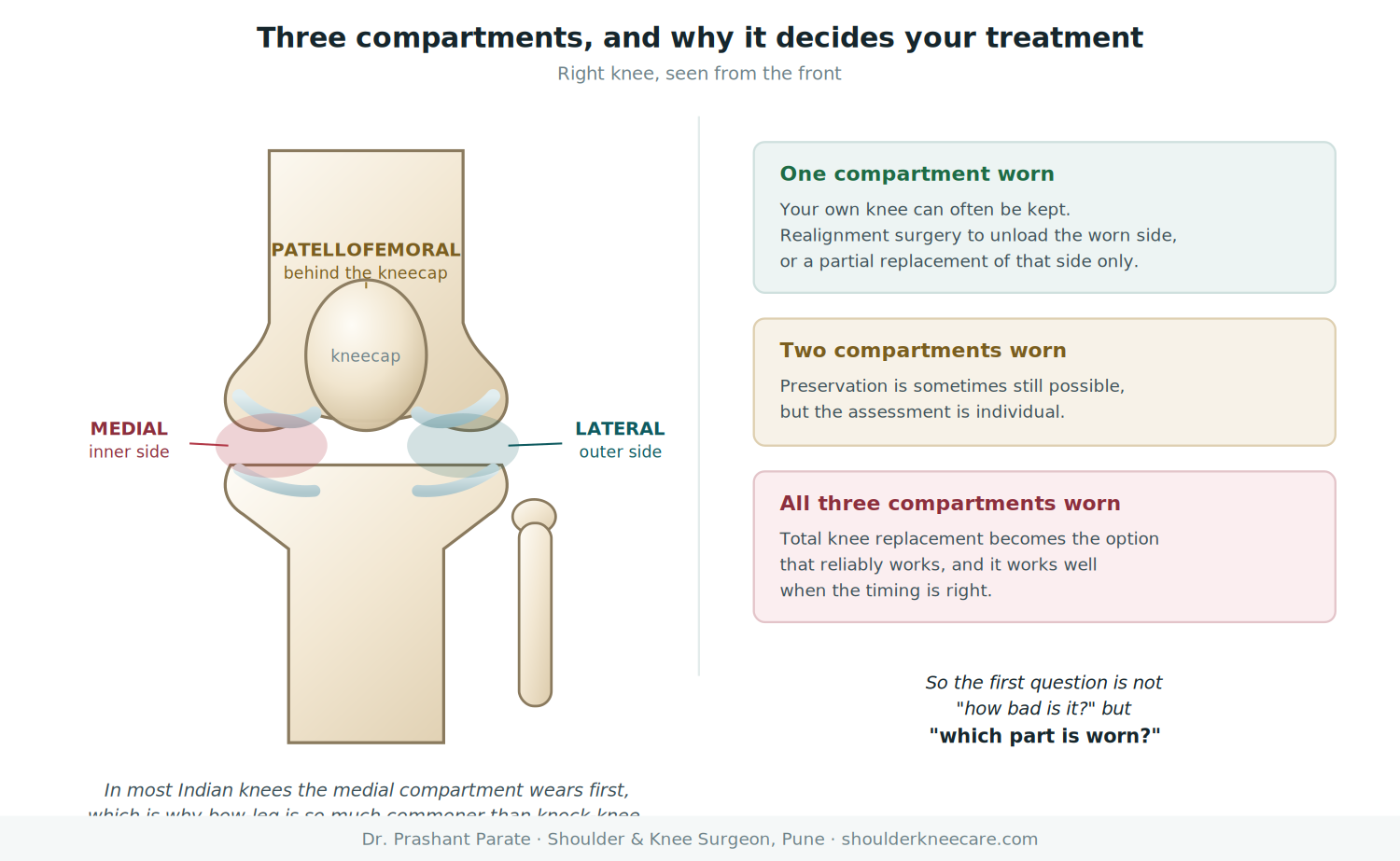
Your knee has three compartments: the medial compartment on the inner side, the lateral on the outer side, and the patellofemoral compartment behind the kneecap.
In the majority of Indian patients the medial compartment wears first and worst, which is why bow-legged deformity is so much more common here than knock-knee. This matters because a knee with one worn compartment and two healthy ones has options that a globally worn knee does not: realignment surgery to shift load away from the damaged side, or a partial replacement resurfacing only that compartment. A knee worn in all three compartments has effectively one surgical option.
The decision pathway
1. Have you genuinely done the basics?
Quadriceps strengthening and weight reduction are not filler advice offered before the real treatment. They are the two most effective non-surgical interventions in knee arthritis, and their effect is larger than most injections. Every kilogram lost removes several times that load from the knee with each step. A knee that has never had three months of proper supervised strengthening has not been treated yet. Start here, always.
2. Is the pain activity-related, or is it present at rest and at night?
Pain that appears with walking and settles with rest usually still has room for non-surgical management. Pain that wakes you at night, or is present when you are sitting still, indicates advanced disease and shifts the conversation towards replacement. Night and rest pain is the strongest single symptom.
3. Is only the inner compartment worn, and is your leg bow-legged?
Then high tibial osteotomy becomes a real option. The upper shin bone is realigned so that load shifts across to the healthy outer compartment, unloading the worn side. It preserves your own knee, allows full squatting and floor sitting afterwards, and can postpone replacement by many years. It suits younger and more active patients particularly well. Consider realignment before replacement.
4. Is one compartment worn with good ligaments and reasonable alignment?
Then partial knee replacement may fit. Only the damaged compartment is resurfaced, the ligaments including the ACL are kept, and the knee feels more natural afterwards with a faster recovery than a total replacement. It is not suitable for everyone, and the assessment is specific. Worth asking about rather than assuming total.
5. Are all three compartments worn, with pain at rest and daily life restricted?
This is where total knee replacement is genuinely the right operation, and where it works extremely well. The test is not what the X-ray shows but what you can no longer do: how far you can walk, whether you sleep through the night, whether you have stopped doing things that matter to you. Replacement, and it should relieve you.
6. Has someone offered you arthroscopy to clean out the arthritis?
Ask carefully what it is expected to achieve. Arthroscopic washout or debridement for arthritis alone has repeatedly been shown not to help, and it does not slow the disease. Arthroscopy has a genuine role when there is a true mechanical problem in an arthritic knee, such as a locked knee or a displaced fragment blocking movement, but that is a different situation from operating on the arthritis itself. Question this one.
Treatment options, honestly assessed
| Treatment | What it does | Honest verdict |
| Strengthening and weight reduction | Reduces load through the joint and improves the muscular support around it | The most effective non-surgical treatment there is. Underused because it requires effort rather than a prescription |
| Activity modification | Reduces the movements that load the joint most, particularly deep squatting and stairs | Genuinely helpful, and does not mean giving up walking, which remains good for the knee |
| Painkillers and anti-inflammatories | Control symptoms during flares | Useful short term. Long-term daily use carries real stomach, kidney and cardiac risks, and is not a plan |
| Steroid injection | Settles an inflammatory flare | Effective for weeks to a few months. Reasonable occasionally, not repeatedly, since frequent injections harm cartilage |
| Hyaluronic acid injection | Supplements joint fluid | Evidence is mixed. Some patients get useful relief for several months, many get little. Best considered in mild to moderate arthritis, not advanced |
| PRP injection | Concentrated platelets from your own blood | Reasonable evidence in mild to moderate arthritis in younger patients. Little value in advanced disease. Not a cartilage regrowth treatment |
| Stem cell therapy | Marketed as regenerating cartilage | The regeneration claim is not supported by current evidence. Expensive, unregulated in much of India, and I would not recommend paying for it |
| High tibial osteotomy | Realigns the limb to unload the worn compartment | Genuinely joint-preserving. The right operation for the right knee, and underused in India |
| Partial knee replacement | Resurfaces one compartment only | Excellent when it fits. Faster recovery and a more natural feeling knee than total replacement |
| Total knee replacement | Resurfaces the whole joint | One of the most reliable operations in orthopaedics when properly indicated. The problem is timing, not the operation |
Can knee replacement be delayed?
Often yes, and for the right patient that is the correct aim. Weight reduction, sustained strengthening, sensible activity modification, occasional injections and, where the pattern of wear allows it, realignment surgery can buy years of comfortable use of your own knee.
But delay has a cost when it is taken too far. A knee left until walking has become minimal loses quadriceps strength, the other knee and the hips take the strain, general fitness declines, and deformity becomes fixed. Recovery after replacement is measurably harder from that starting point. The aim is not to postpone surgery for as long as physically possible. It is to have it at the point where it genuinely improves your life, and not before.
The honest framing: preserve the natural joint whenever preservation can still give reliable relief and function. Replace it when it can no longer do so.
Life after knee replacement, realistically
A well-done knee replacement reliably relieves arthritic pain and restores comfortable walking, stairs, and normal daily activity. Most patients return to routine life within a few months and describe it as one of the best decisions they made.
What it does not do is give you back a nineteen-year-old knee. Deep squatting and prolonged cross-legged sitting are usually limited afterwards, which matters more in India than in Western practice, and you should hear this before surgery rather than discover it later. Many patients manage floor sitting to some degree, but it is not guaranteed and should not be promised. Running and jumping sports are not advised. Modern implants commonly last fifteen to twenty years or more, which is why age and activity influence timing.
Cost and insurance in Pune
Total knee replacement in Pune typically ranges between ₹2 and ₹4.5 lakh per knee, depending on hospital category, implant, and room type. Robotic-assisted replacement generally adds to that. High tibial osteotomy and partial knee replacement usually cost less than a total replacement.
Knee replacement is covered by most health insurance policies, with cashless treatment at empanelled hospitals, and is also covered under many government and corporate schemes. Two practical points: most policies impose a waiting period of two to four years for joint replacement, so check your policy start date, and begin pre-authorisation well before a planned date.
Indicative ranges, not quotations. An exact estimate is given after assessment.
Frequently asked questions
My X-ray says bone on bone. Do I have to have a replacement?
Not automatically. Bone on bone describes the film, not your life. If your pain is manageable, you sleep through the night, and you are doing what you need to do, there is no obligation to operate on an X-ray. The decision comes from your symptoms and your function, with the X-ray as supporting information.
Will walking damage my knee further?
No, and this is one of the most damaging misconceptions in arthritis. Walking maintains cartilage nutrition, muscle strength and general health, and inactivity makes arthritic knees worse rather than better. What is worth reducing is deep squatting, repeated stair climbing and heavy load carrying. Level walking is good for you.
Can I sit cross-legged after a knee replacement?
Sometimes, partly, and it should not be promised. Many patients achieve a degree of floor sitting, but deep squatting and prolonged cross-legged sitting are usually restricted, and anyone guaranteeing otherwise is overselling. If floor sitting is essential to your daily life or religious practice, say so clearly before surgery, because it may influence both timing and whether joint preservation is a better fit for you.
Am I too young for a knee replacement?
Age matters, but as one factor rather than a rule. A replacement in a younger patient is more likely to need revision within their lifetime, which is exactly why joint-preserving options such as osteotomy and partial replacement deserve serious consideration first in that group. If preservation genuinely will not give you a usable knee, being young is not a reason to spend a decade in pain.
Do I need both knees done, and can they be done together?
Both knees are often affected, but they are rarely equally symptomatic, and operating on the worse one frequently improves the other by restoring normal walking. Doing both in one sitting is possible in selected fit patients and is a decision made on your general health rather than convenience. Most patients are better served by staging them.
Does knee arthritis run in families?
There is a familial tendency, particularly for the pattern of alignment and cartilage quality you inherit. It is not destiny. Weight, muscle strength, previous injury and previous surgery all influence how a knee ages, and those are the parts you can act on.
Do knee braces, supports and supplements help?
An unloader brace can genuinely help selected patients with single-compartment arthritis, though many find them cumbersome in Indian conditions. Simple elastic supports mostly provide reassurance rather than mechanical benefit, which has some value but is not treatment. Glucosamine and similar supplements have weak evidence overall, and I would not spend significant money on them.
I was told I need surgery, but I want another opinion. Is that reasonable?
Entirely reasonable, and I would encourage it particularly if replacement has been advised on the basis of an X-ray without a detailed discussion of your symptoms, or if joint-preserving alternatives were never mentioned. Bring your standing X-rays and any alignment films.
Key takeaways
- The X-ray does not decide. Your symptoms, your function and your night pain do.
- Strengthening and weight reduction outperform most injections, and are the foundation of every plan.
- Which compartment is worn changes the options entirely. Ask whether yours is one compartment or all three.
- Bow-legged knee with inner-compartment wear: ask about realignment before agreeing to replacement.
- Arthroscopy does not treat arthritis. Question it if offered for that purpose.
- Replacement is an excellent operation at the right time. The skill is in the timing, not the technique alone.
Told you need a knee replacement? Ask what else was considered.
Bring your standing X-rays. In one consultation you will know which compartments are affected, whether joint preservation is still open to you, and whether replacement is genuinely the right step now or later.
Appointments by phone
Sainath Hospital, Moshi, PCMC
86000 05886
Mon to Fri, 10 am to 4 pm · Sat, 10 am to 12 noon
Jupiter Hospital, Baner, Pune
020 2799 2150
Mon to Sat, 5.30 pm to 6.30 pm · OPD 5
All consultations by prior appointment. Timings may vary with the surgical schedule.
This page is patient education, not a substitute for consultation. Treatment decisions require clinical examination and imaging review. Last medically reviewed: July 2026 by Dr. Prashant Parate, DNB Orthopaedics, Fellowship in Arthroscopy & Sports Medicine (Thammasat University Hospital, Thailand). MMC Reg. 2006042129.