SHOULDER · STABILISATION SURGERY
Bankart, remplissage or Latarjet: how the choice is actually made.
Three operations stabilise a dislocating shoulder, and they are not interchangeable. Choosing the smaller operation for a shoulder that needed the bigger one is the commonest reason stabilisation fails. This explains what each does, and what decides between them.
Dr. Prashant Parate · Shoulder, Knee & Sports Injury Surgeon · In orthopaedic practice since 2010, DNB-qualified since 2012 · Jupiter Hospital (Baner) & Sainath Hospital (Moshi, PCMC) · Reviewed July 2026
Read first: Shoulder Dislocation and Instability, which covers whether you need surgery at all. This page assumes that decision is made.
The three operations at a glance
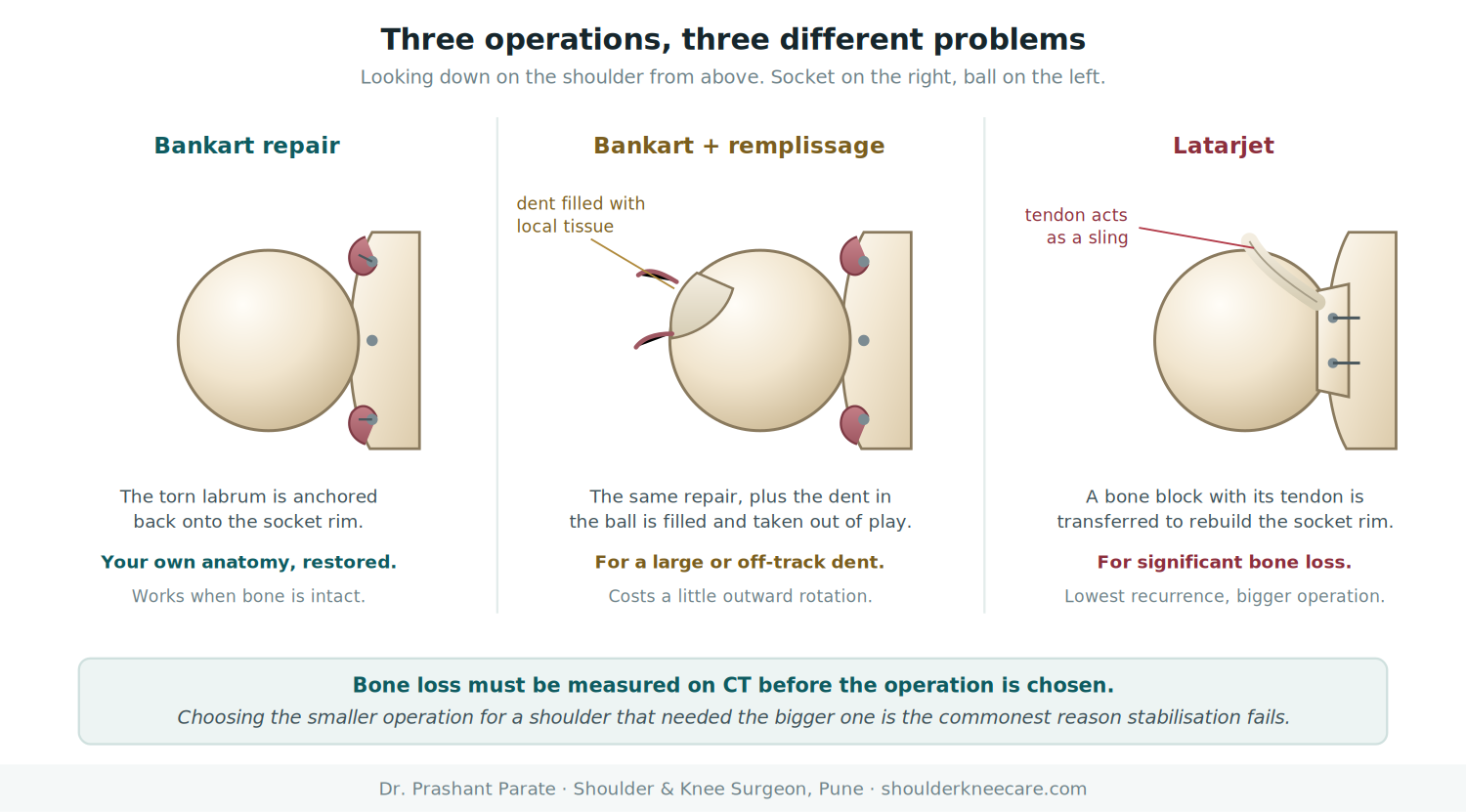
All three aim at the same thing: stopping the ball coming out of the front of the socket. They achieve it differently, and the difference matters most when bone has been lost.
Bankart repair
This is the anatomical repair. Through keyhole portals, the torn labrum and the ligaments attached to it are lifted back onto the front rim of the socket and held there with small anchors, usually three or four, until they heal back down. Nothing is added to the shoulder that was not there before. Your own anatomy is put back where it belongs.
It works well when the bone is intact. In a shoulder with little or no socket bone loss and a Hill-Sachs dent that stays on-track, a properly done Bankart repair gives a low recurrence rate, preserves rotation well, and is the least invasive of the three.
It fails more often when bone is missing, because soft tissue is being asked to compensate for a socket that has lost its shape. This is the situation where recurrence rates climb, and it is the single most important judgement in this area of surgery.
Bankart repair with remplissage
Remplissage means filling. It addresses the other half of the problem: the dent pressed into the back of the ball.
The tissue at the back of the shoulder, the posterior capsule together with the infraspinatus tendon, is stitched down into the dent so that the dent is filled and taken out of the joint. It can then no longer catch on the front rim of the socket as the arm goes up and back. It is done arthroscopically at the same sitting as the Bankart repair, and adds relatively little to the recovery.
When it is added: a large Hill-Sachs dent, or an off-track lesion, in a shoulder where socket bone loss is not severe enough to require a bone transfer. It converts a repair likely to fail into one likely to hold.
The trade: some loss of outward rotation, usually modest and rarely noticed in daily life. Throwing athletes are the group most likely to notice it, and that is worth discussing before surgery rather than after.
Latarjet
This is the bone operation, and it does three things at once, which is why it is so effective in difficult shoulders.
A small block of bone called the coracoid, which sits just in front of the shoulder, is cut and transferred to the front rim of the socket, where it is fixed with screws. The tendon still attached to that bone block is brought through the front of the shoulder as it goes.
- It restores bone. The block rebuilds the missing front edge of the socket, widening the track and giving the ball a deeper surface to sit against.
- It adds a sling. The transferred tendon passes across the front of the joint and acts as a dynamic restraint, tightening exactly in the position where the shoulder is most at risk.
- It repairs the capsule. The capsule is reattached over the block, adding a third layer of restraint.
When it is chosen: significant socket bone loss, a failed previous stabilisation, and often collision athletes even with lesser bone loss, because the recurrence rate is very low. It can be done open or arthroscopically.
The trade: it is a bigger operation with a higher complication rate than an arthroscopic Bankart repair, including problems related to the screws, the bone block not uniting, and nerve irritation. It is not the default operation. It is the right operation for the right shoulder.
What actually decides between them
| Finding | Usual choice |
| Little or no socket bone loss, on-track lesion | Arthroscopic Bankart repair |
| Large Hill-Sachs dent or off-track lesion, socket bone largely preserved | Bankart repair with remplissage |
| Significant socket bone loss | Latarjet |
| Previous stabilisation that failed | Usually Latarjet, after establishing why the first one failed |
| Collision athlete, even with moderate bone loss | Latarjet is often preferred for its low recurrence rate |
| Shoulder loose without injury, generally flexible joints | Rehabilitation first. Surgery is rarely the answer here |
This is why the imaging matters so much. Socket bone loss and the size of the dent should be measured on CT with three-dimensional reconstruction before the operation is planned. A shoulder taken to theatre without that measurement risks getting the smaller operation when it needed the larger one.
Recovery compared
| Stage | Bankart, with or without remplissage | Latarjet |
| Week 0 to 4 | Sling. Gentle assisted movement, avoiding the provocative position | Sling. Similar early protection while the bone block unites |
| Week 4 to 12 | Sling off. Range restored progressively, then strengthening | Sling off. Range restored, with attention to the front of the shoulder |
| Month 3 to 6 | Strengthening, then sport-specific work | Similar, once bone healing is confirmed |
| Return to sport | Around 6 months, after testing | Around 6 months, after testing and confirmed union |
Recovery timelines are broadly similar, which surprises patients who expect the bigger operation to take much longer. The differences lie in the complication profile and in the recurrence rate, not in how long you spend in a sling.
Frequently asked questions
Is Latarjet better than Bankart repair?
Not in general, only in the right shoulder. Latarjet has a lower recurrence rate but a higher complication rate and involves permanently altering anatomy. For a shoulder with intact bone, an arthroscopic Bankart repair is the better operation. For a shoulder with significant bone loss, Latarjet is clearly better, because a Bankart repair there is likely to fail.
Does remplissage limit my movement?
It usually costs a modest amount of outward rotation. Most patients do not notice it in daily activity or in most sports. Throwing athletes and some overhead athletes are the group where it matters, and in that group the trade-off deserves specific discussion beforehand.
Why did my first stabilisation surgery fail?
The three usual reasons are unrecognised bone loss at the time of the first operation, returning to sport before the shoulder was ready, and a further significant injury. Establishing which applies matters, because it changes what the revision operation should be. A failed repair should not simply be repeated.
Can Latarjet be done by keyhole surgery?
Yes, arthroscopic Latarjet is established, though it is technically demanding. Whether it is done open or arthroscopically matters less to the outcome than whether the bone block is positioned accurately and heals, which is the part that determines success either way.
Will I get arthritis in that shoulder later?
Repeated dislocations themselves damage cartilage and raise arthritis risk, which is one argument for stabilising sooner rather than accumulating episodes. Stabilisation surgery reduces that risk by stopping the dislocations, though a poorly positioned bone block can itself cause wear, which is why placement accuracy matters.
Do the screws need removing later?
Usually not. They are designed to stay. Removal is occasionally needed if a screw becomes prominent or causes irritation, but that is uncommon and not something to plan for.
Can I go back to gym and contact sport?
Most patients do. Gym work resumes progressively from around three months, with overhead and heavy pressing later. Contact sport is generally around six months and should follow testing rather than a date. Latarjet is often preferred for collision athletes precisely because it holds up well under those demands.
Key takeaways
- These are not three grades of the same operation. They solve different problems.
- Bankart repair restores your own anatomy and works well when bone is intact.
- Remplissage takes the dent out of play, and costs a little outward rotation.
- Latarjet restores bone, adds a sling and repairs the capsule. Lower recurrence, higher complication rate.
- Bone loss must be measured on CT before the operation is chosen.
- Choosing the smaller operation for a shoulder that needed the bigger one is the commonest reason stabilisation fails.
Been offered stabilisation surgery, or had one that failed?
Bring your scans, including any CT. You will find out how much bone has been lost, which of these operations fits your shoulder, and what return to your sport realistically looks like.
Appointments by phone
Sainath Hospital, Moshi, PCMC
86000 05886
Mon to Fri, 10 am to 4 pm · Sat, 10 am to 12 noon
Jupiter Hospital, Baner, Pune
020 2799 2150
Mon to Sat, 5.30 pm to 6.30 pm · OPD 5
All consultations by prior appointment. Timings may vary with the surgical schedule.
This page is patient education, not a substitute for consultation. Treatment decisions require clinical examination and imaging review. Last medically reviewed: July 2026 by Dr. Prashant Parate, DNB Orthopaedics, Fellowship in Arthroscopy & Sports Medicine (Thammasat University Hospital, Thailand). MMC Reg. 2006042129.