SHOULDER · DISLOCATION AND INSTABILITY
Shoulder keeps dislocating? The age at your first one predicts the rest better than anything else.
A shoulder that has dislocated once in a young patient has a high chance of doing it again, and each episode does further damage. This guide explains what actually tears when a shoulder comes out, why bone loss changes the whole operation, and how the choice between the different stabilising procedures is made.
Dr. Prashant Parate · Shoulder, Knee & Sports Injury Surgeon · In orthopaedic practice since 2010, DNB-qualified since 2012 · Jupiter Hospital (Baner) & Sainath Hospital (Moshi, PCMC) · Reviewed July 2026
Related: Shoulder Pain: Which Pattern Is Yours?
Why the shoulder dislocates at all
The shoulder trades stability for movement. The socket is shallow, roughly the proportions of a golf ball sitting on a tee, which is what allows the arm to reach in almost any direction. What keeps the ball centred is a rim of cartilage around the socket edge called the labrum, the capsule and ligaments attached to it, and the muscles around the joint.
When the arm is forced up and back, in the position of throwing or of falling backwards onto an outstretched hand, the ball can be levered forward out of the socket. This is anterior dislocation, and it accounts for the large majority of cases.
What tears, and what dents
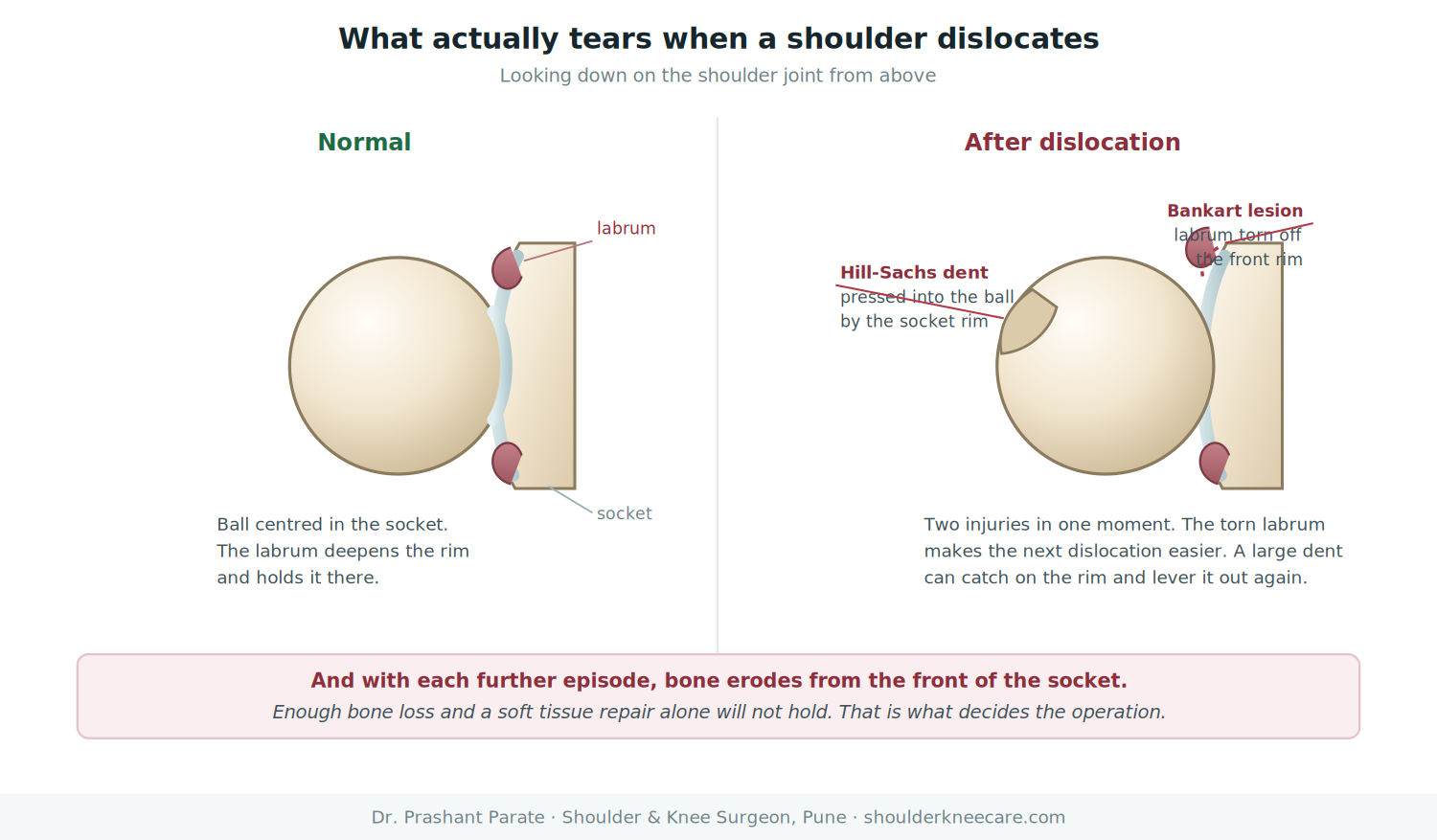
Two things typically happen at the same moment, and both matter for treatment.
A Bankart lesion. The labrum, with the ligaments attached to it, is torn off the front rim of the socket. Once detached it often heals in a stretched or displaced position, which leaves the front of the shoulder permanently less able to resist the ball moving forward. This is why the second dislocation happens more easily than the first.
A Hill-Sachs lesion. As the ball sits dislocated against the hard front rim of the socket, the rim presses a dent into the back of the ball. A small dent is of no consequence. A large one matters, because when the arm goes up and back, that dent can engage with the socket rim and lever the shoulder out again.
And with repeated episodes, bone erodes. Each dislocation chips and wears the front rim of the socket. Over several episodes the socket loses its shape, going from a pear outline to something flatter. A shoulder with significant bone loss cannot be reliably stabilised by repairing soft tissue alone, and this single finding changes the operation entirely.
Age at first dislocation: the number that predicts everything
This is the most useful thing known about shoulder instability, and it is rarely explained to patients.
| Age at first dislocation | Chance of it happening again | What that means |
| Under 20 | Very high, the majority will recur | Early stabilisation is worth discussing seriously, particularly in contact sport |
| 20 to 30 | High | Depends heavily on sport and occupation |
| 30 to 40 | Moderate | Rehabilitation first is usually reasonable |
| Over 40 | Low recurrence, but different concern | A rotator cuff tear caused by the dislocation becomes more likely than repeat instability, and should be looked for |
The practical consequence: a first dislocation at 18 in someone who plays contact sport is a very different conversation from a first dislocation at 55. The young patient is being advised about preventing a pattern. The older patient is being assessed for a cuff tear.
Why bone loss changes the operation
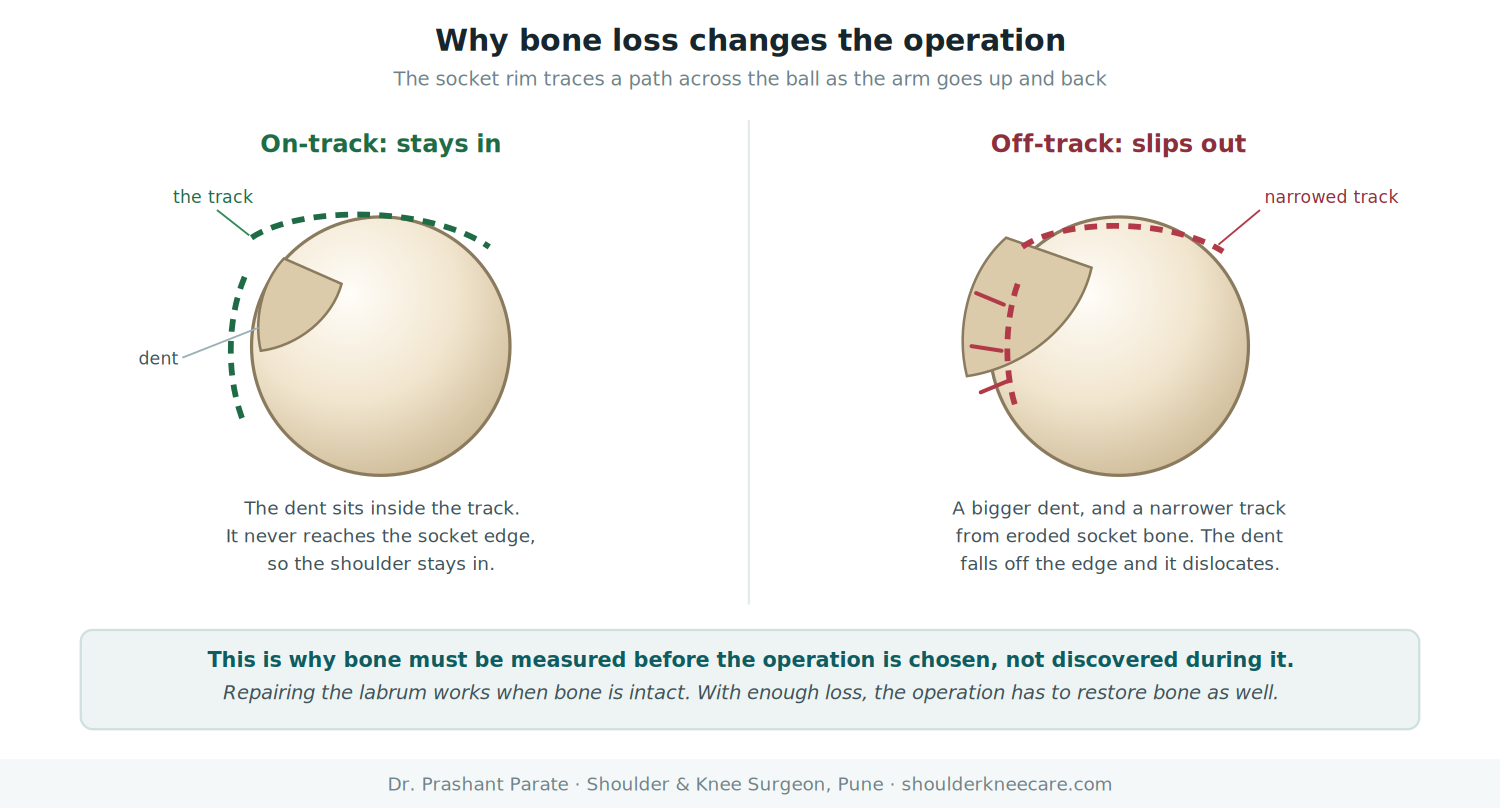
Think of it as a track. As the arm moves up and back, the socket rim traces a path across the back of the ball. If the dent in the ball stays within that path, the shoulder remains stable. If the dent extends beyond it, the dent falls off the edge and the shoulder dislocates. Surgeons describe these as on-track and off-track lesions.
Two things push a shoulder off-track: a bigger dent in the ball, and a narrower track, which is what happens when the front of the socket erodes. This is why bone loss on both sides has to be measured before choosing an operation, usually on CT with a three-dimensional reconstruction rather than on MRI alone.
The consequence is simple. Repairing the torn labrum works well when the bone is largely intact. When enough bone has been lost, a soft tissue repair alone has a meaningfully higher failure rate, and the operation needs to restore bone or address the dent as well. Choosing the soft tissue repair for a shoulder that needed more is one of the commonest reasons stabilisation surgery fails.
The decision pathway
1. Is this a first dislocation, and how old are you?
Under 20 in contact or overhead sport: stabilisation after a first dislocation is a genuine option worth discussing, because the recurrence rate without it is high and each further episode causes more damage. Older and less demanding: rehabilitation first is entirely reasonable. Age and demand decide, not the number of episodes alone.
2. Has it dislocated more than once?
Recurrent instability rarely settles with physiotherapy alone, because the anatomy that should hold the shoulder in place is detached or stretched. Continuing to dislocate is not a benign state: it erodes bone and damages cartilage each time. Recurrent dislocation is a surgical conversation.
3. How much bone has been lost, and is the lesion on-track or off-track?
This is the measurement that decides which operation. It needs proper imaging, and it should be done before surgery is planned rather than discovered during it. Measure the bone before choosing the procedure.
4. What do you actually do with the shoulder?
Collision sport, overhead work at height, and occupations where a shoulder giving way would be dangerous all raise the threshold for accepting an instability and lower the threshold for a more robust operation. A sedentary patient who only feels apprehension in unusual positions has different needs. Demand shapes the choice.
5. Are you over 40 with a dislocation and persistent weakness?
Then the question is not primarily instability. A dislocation in this age group can tear the rotator cuff, and persistent inability to lift the arm several weeks afterwards should be investigated rather than attributed to stiffness. Look for a cuff tear, not just instability.
6. Does your shoulder feel loose without any injury, and are your other joints very flexible?
Some shoulders are unstable because the tissues are generally lax rather than because something tore. This group often does genuinely well with a dedicated strengthening programme, and surgery is much less often the answer. Distinguishing this from traumatic instability matters a great deal. Rehabilitation, not surgery, for most.
The stabilising operations, in outline
Each of these is covered in more detail in a separate guide, but here is how they relate to one another.
| Procedure | What it does | Suited to |
| Arthroscopic Bankart repair | Keyhole reattachment of the torn labrum and ligaments to the socket rim with anchors | Recurrent instability with little or no bone loss, and an on-track lesion |
| Bankart repair plus remplissage | The same repair, plus filling the dent in the back of the ball with local tissue so it can no longer engage the socket rim | A significant Hill-Sachs dent or an off-track lesion, without major socket bone loss |
| Latarjet | A small block of bone with its attached tendon is transferred to the front of the socket, restoring bone and adding a dynamic restraint | Significant socket bone loss, failed previous repair, and often collision athletes |
| Structured rehabilitation | Strengthening the cuff and shoulder blade muscles to compensate | First dislocation in a lower-demand patient, and most cases of generalised laxity |
Recovery and return to sport
| Stage | What happens |
| Week 0 to 4 | Sling protection. Gentle assisted movement within safe limits, deliberately avoiding the position that provokes instability. |
| Week 4 to 12 | Sling discontinued. Range progressively restored, including the outward rotation that was protected early. Strengthening begins. |
| Month 3 to 6 | Serious strengthening, then sport-specific and throwing work. Most daily activity is unrestricted by now. |
| Month 6 to 9 | Return to contact and overhead sport, after testing rather than by date alone. Returning before the shoulder is ready is a common cause of recurrence. |
Cost and insurance in Pune
Arthroscopic shoulder stabilisation in Pune typically ranges between ₹1.5 and ₹3 lakh, varying with hospital category, the number of anchors required, and whether additional procedures are done at the same time. Latarjet is usually in a similar range.
Most insurance policies cover shoulder stabilisation surgery, cashless at empanelled hospitals. Where the original dislocation followed an accident or injury, tell your insurer clearly, since accident-related claims are processed differently, and begin pre-authorisation several days before a planned date.
Indicative ranges, not quotations. An exact estimate follows assessment and imaging.
Frequently asked questions
My shoulder went back in by itself. Does that still count as a dislocation?
Yes. Whether it needed a doctor to relocate it or slipped back on its own, the same structures were damaged. A shoulder that partially slips and returns, called a subluxation, causes similar damage and carries similar implications. Do not discount an episode because you did not go to hospital for it.
Will physiotherapy alone fix a recurrent dislocation?
Usually not, if the instability is traumatic in origin. Physiotherapy strengthens muscles, but it cannot reattach a labrum that has torn off the socket rim or restore bone that has eroded. It genuinely helps the group whose shoulders are loose because of generalised tissue laxity rather than injury, which is why distinguishing the two matters so much.
How many dislocations before surgery is advised?
There is no fixed number, and treating it as a threshold is a mistake. A young contact athlete may be advised after one. A low-demand patient in their forties may reasonably continue without surgery after two. What matters is age, sport, occupation, bone loss and how much the shoulder limits you.
Will I be able to play contact sport again?
Most patients return to their sport after stabilisation surgery. The specific procedure matters here, and this is one reason a Latarjet is often favoured for collision athletes and for shoulders with bone loss. Return should follow testing rather than a calendar date, typically somewhere between six and nine months.
Will my shoulder be stiff afterwards?
Some loss of outward rotation is common and usually minor. It is a deliberate trade, since a shoulder that is slightly tight at the extreme is more stable. Most patients do not notice it in daily life, though throwing athletes may.
What happens if I just live with it?
Some people do, particularly if episodes are infrequent and easily avoided. The cost is cumulative: each dislocation erodes more bone, damages cartilage, and makes both the next dislocation and eventual arthritis more likely. It also converts a shoulder that a straightforward keyhole repair could have fixed into one needing a bigger operation.
Can stabilisation surgery fail?
It can. The commonest reasons are unrecognised bone loss at the time of surgery, returning to sport too early, and a further significant injury. Unrecognised bone loss is the one most within our control, which is why measuring it properly beforehand is emphasised so strongly.
Key takeaways
- Age at first dislocation predicts recurrence better than anything else. Under 20 is a high-risk group.
- Each dislocation erodes bone. Waiting can turn a keyhole repair into a bigger operation.
- Bone loss must be measured before choosing the procedure, not discovered during it.
- Over 40, a dislocation with lasting weakness usually means a cuff tear rather than instability.
- Shoulders that are loose without injury are a different problem and mostly respond to strengthening.
- Return to sport after testing, not by date. Early return is a leading cause of recurrence.
Shoulder dislocated more than once?
Bring your scans. You will find out how much bone has been lost, whether a keyhole repair is still enough, and what a realistic return to your sport or work looks like.
Appointments by phone
Sainath Hospital, Moshi, PCMC
86000 05886
Mon to Fri, 10 am to 4 pm · Sat, 10 am to 12 noon
Jupiter Hospital, Baner, Pune
020 2799 2150
Mon to Sat, 5.30 pm to 6.30 pm · OPD 5
All consultations by prior appointment. Timings may vary with the surgical schedule.
This page is patient education, not a substitute for consultation. Treatment decisions require clinical examination and imaging review. Last medically reviewed: July 2026 by Dr. Prashant Parate, DNB Orthopaedics, Fellowship in Arthroscopy & Sports Medicine (Thammasat University Hospital, Thailand). MMC Reg. 2006042129.