KNEE · AVULSION FRACTURE FIXATION
When the ligament did not tear: bony avulsions, and why they are good news.
In many younger patients, particularly after two-wheeler accidents, the cruciate ligament does not tear in its middle. It pulls off taking a piece of bone with it. That distinction matters enormously, because bone heals back to bone far more reliably than a reconstructed ligament ever heals, and the fragment can be fixed through keyhole surgery.
Dr. Prashant Parate · Shoulder, Knee & Sports Injury Surgeon · In orthopaedic practice since 2010, DNB-qualified since 2012 · Jupiter Hospital (Baner) & Sainath Hospital (Moshi, PCMC) · Reviewed July 2026
Related: ACL Tear and Reconstruction, PCL Injury and Multi-Ligament Knee Injury
Two ways the same ligament fails
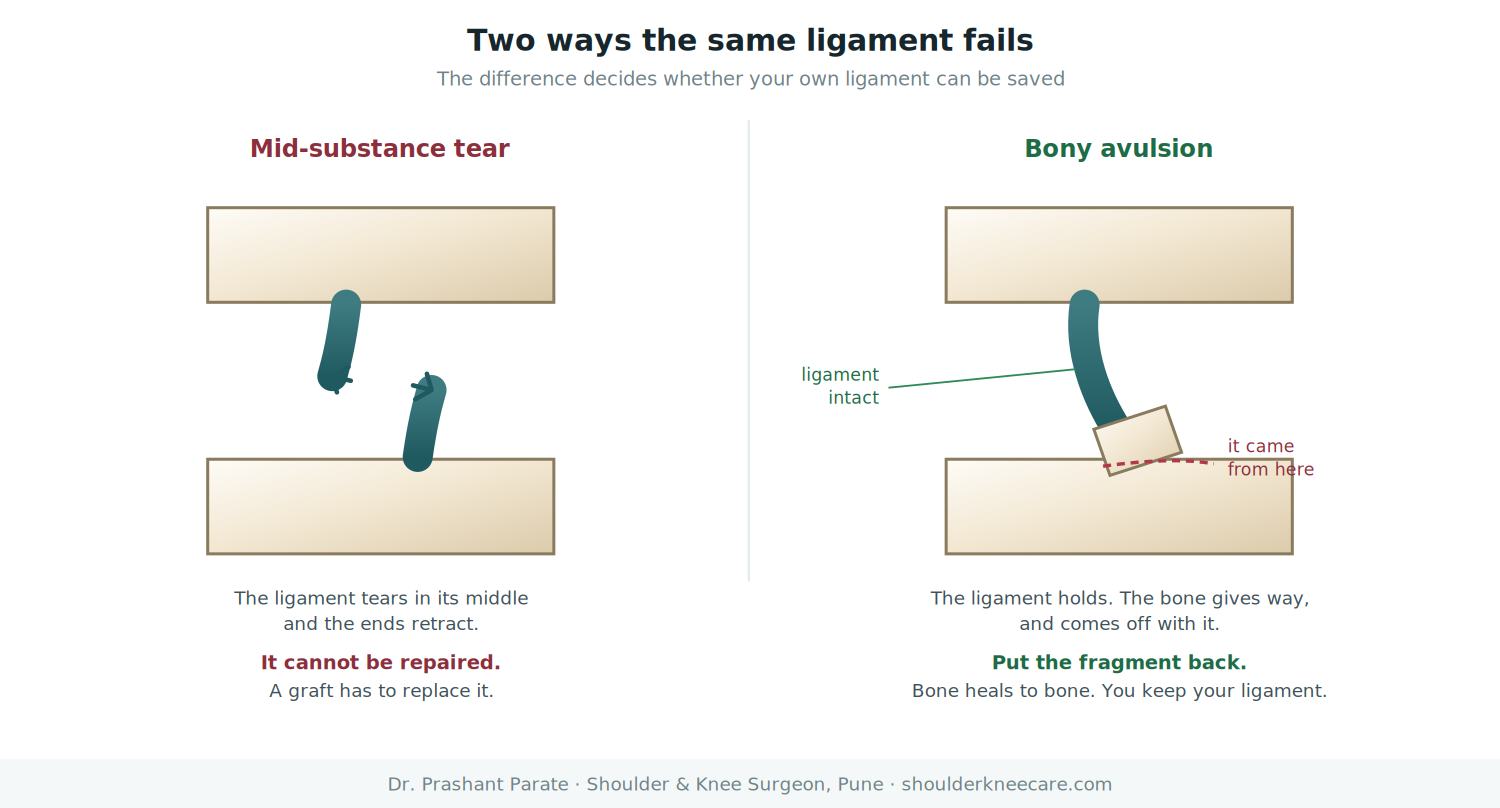
When a cruciate ligament is subjected to more force than it can take, the failure happens at the weakest point in the chain. In an adult with mature bone, that is usually the middle of the ligament, which tears and retracts. The ligament cannot be repaired and has to be replaced with a graft.
In a younger patient whose bone is still relatively soft, and in a good number of adults too, the ligament itself holds and the bone gives way instead. The ligament pulls off with its attachment, taking a fragment of bone with it. The ligament is intact and undamaged. It has simply been detached, with its anchor still attached to it.
This is a much better injury to have, because the fix is to put the fragment back where it came from and let bone heal to bone. Bone-to-bone healing is more reliable and more complete than the process of a tendon graft turning into a ligament, which takes many months and never quite reproduces the original.
Why we see so many of these
Avulsion injuries appear far more often in Indian practice than Western case series would suggest, and the reason is the mechanism. Two-wheeler accidents produce exactly the loading pattern that causes them: a direct blow to the front of the shin driving it backwards, which avulses the PCL from its bed on the back of the tibia, or a hyperextension and twisting injury that pulls the ACL off the tibial spine.
The patients are frequently young, otherwise healthy, and have decades of use ahead of them, which is exactly the group in whom preserving their own ligament rather than replacing it is most worth achieving.
Recognising it
Unlike a mid-substance tear, a bony avulsion is often visible on a plain X-ray, since it involves bone. A fragment sitting away from the tibial spine, or a piece of bone lifted off the back of the tibia, is the finding to look for. It is also easy to overlook on a single view, particularly when attention is on other injuries after a road accident.
CT gives the clearest picture of the fragment size, its position and whether it is rotated, which matters for planning fixation. MRI confirms the ligament is intact and shows what else has been injured.
Time matters here more than in almost any other knee injury
A fresh fragment can be lifted, cleaned and returned precisely to its bed. After a few weeks it begins to unite in whatever position it settled, often lifted and rotated, and it can no longer be reduced. At that point the options narrow to reconstruction, and a straightforward fixation that would have restored the patient’s own ligament is no longer available. These should be fixed within the first two to three weeks wherever possible.
How the fixation is done
Both ACL and PCL avulsions can be fixed arthroscopically, through keyhole portals, which avoids the large open exposure that these injuries traditionally required, particularly at the back of the knee where the PCL attaches.
The joint is cleared of clot, the bed the fragment came from is cleaned so bone can heal to bone, and any tissue trapped underneath the fragment is freed, since a fragment sitting on soft tissue will not unite. The fragment is then reduced back into place and held.
Suture fixation passes strong sutures through the base of the ligament and down through small bone tunnels, tying them over the front of the tibia to pull the fragment firmly into its bed. It handles small or fragmented pieces that a screw would split, and there is no metal to remove later.
Screw fixation suits a single large fragment with good bone quality, and gives immediate rigid compression.
The choice depends on the size and quality of the fragment, and the aim of both is the same: the fragment sitting flush in its bed, held firmly enough for bone to heal to bone.
Recovery
| Stage | What happens |
| Week 0 to 6 | Brace and protected weight-bearing while the fragment unites. Controlled movement begins early to prevent stiffness, within limits set at surgery. |
| Week 6 to 12 | Union confirmed on X-ray. Weight-bearing and range progress, strengthening begins. |
| Month 3 to 6 | Strengthening and balance work. Most daily and work activity returns. |
| Month 6 to 9 | Return to sport after testing. Often earlier than after a ligament reconstruction, because there is no graft waiting to mature. |
Results are generally very good when the fragment is reduced accurately and fixed early. The patient keeps their own ligament with its own blood supply and nerve endings, which is not something any reconstruction can offer. The main complication to watch for is stiffness, which is why early controlled movement is emphasised.
If it was missed
A missed avulsion produces a knee that feels unstable, often with a history of an accident months or years earlier and an X-ray nobody looked at closely. The fragment has united in a lifted position, leaving the ligament effectively lengthened and the knee loose.
These are still treatable. Depending on the fragment and how long it has been, options include taking the malunited fragment down and refixing it correctly, or reconstructing the ligament conventionally. The result is generally good, but it is a bigger operation than the one that was available in the first three weeks, which is the whole argument for recognising these early.
Frequently asked questions
Is an avulsion better or worse than a normal ligament tear?
Better, provided it is recognised and fixed in time. You keep your own ligament rather than having it replaced with a tendon graft, the healing is bone to bone which is more reliable, and return to activity is often quicker. The catch is entirely about timing.
My X-ray was reported as normal but my knee feels loose. Could this have been missed?
It is possible, particularly if the films were taken after a road accident when attention was on other injuries, or if only one view was taken. A small avulsed fragment is easy to overlook. If your knee has felt unstable since a specific accident, it is worth having the original films reviewed rather than assuming a normal report settled the matter.
Does the metal need to be removed later?
With suture fixation there is nothing to remove. With a screw, removal is occasionally needed if it becomes prominent or irritating once the bone has healed, but it is not routine and not something to plan for.
Can this be done in children?
Yes, and avulsion is actually the typical pattern in children, whose growing bone is softer than their ligaments. Fixation in a growing knee requires care to avoid the growth plates, which is a specific technical consideration, but the principle of restoring the child’s own ligament rather than reconstructing it is if anything more compelling in this group.
Why does it need surgery if the ligament is intact?
Because the ligament is only as useful as its attachment. A fragment sitting lifted out of its bed heals in that position, leaving the ligament functionally too long and the knee unstable. Fixing the fragment back restores the correct length and tension, which is what makes the ligament work again.
Can a small avulsion be treated in a cast instead?
Occasionally, for an undisplaced fragment that sits in its bed on imaging. But displaced fragments will not reduce themselves, and prolonged immobilisation in a cast carries a real risk of permanent stiffness. Arthroscopic fixation allows early controlled movement, which is generally the better trade.
Key takeaways
- An avulsion means your ligament is intact. Only its bony anchor came off.
- Bone heals to bone more reliably than a graft matures into a ligament.
- Common after two-wheeler accidents, and common in children and younger patients.
- Often visible on plain X-ray, and easily overlooked when other injuries dominate.
- Fix within two to three weeks. After that the fragment unites in the wrong position.
- Both ACL and PCL avulsions can be fixed arthroscopically, avoiding a large open approach.
Recent accident with an unstable knee?
If an avulsion is present, the window for the simplest and best operation is the first two to three weeks. Bring your X-rays, including any taken on the day of the accident.
Appointments by phone
Sainath Hospital, Moshi, PCMC
86000 05886
Mon to Fri, 10 am to 4 pm · Sat, 10 am to 12 noon
Jupiter Hospital, Baner, Pune
020 2799 2150
Mon to Sat, 5.30 pm to 6.30 pm · OPD 5
This page is patient education, not a substitute for consultation. Treatment decisions require clinical examination and imaging review. Last medically reviewed: July 2026 by Dr. Prashant Parate, DNB Orthopaedics, Fellowship in Arthroscopy & Sports Medicine (Thammasat University Hospital, Thailand). MMC Reg. 2006042129.